
Table of Contents
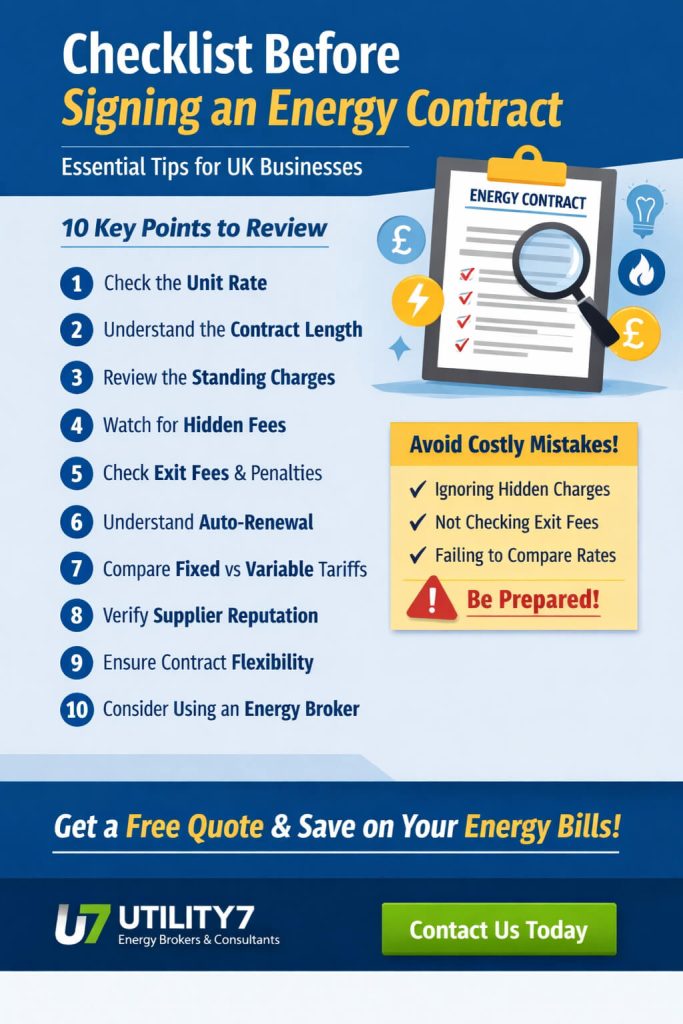
Toggle10-Point Checklist Before Signing an Energy Contract
1. Check the Unit Rate (Price per kWh)
The unit rate determines how much you pay per kWh of electricity or gas.
- Compare rates from multiple suppliers
- Ensure the rate is competitive for your business size
2. Understand the Contract Length
Energy contracts typically range from 1 to 5 years.
- Short-term = more flexibility
- Long-term = price stability
Choose based on your business goals and market conditions.
3. Review the Standing Charges
Standing charges are fixed daily costs regardless of usage.
- Check the daily rate
- Calculate monthly impact
Even a small daily charge can significantly affect annual costs.
4. Look for Hidden Fees
Some contracts include additional costs such as:
- Administration fees
- Metering charges
- Service fees
Always read the fine print.
5. Check Exit Fees and Penalties
Leaving a contract early can be expensive.
- Review termination charges
- Understand conditions for switching suppliers
6. Understand Auto-Renewal Terms
Many contracts automatically renew if no action is taken.
- Check renewal notice period
- Avoid being locked into expensive rollover rates
7. Compare Fixed vs Variable Tariffs
- Fixed tariffs: stable prices
- Variable tariffs: prices may rise or fall
Choose based on your risk tolerance and market trends.
8. Verify Contract Flexibility
If your business grows or changes:
- Can you upgrade or downgrade usage?
- Can you add multiple sites?
Flexibility is crucial for scaling businesses.
9. Check Supplier Reputation
Not all energy suppliers offer the same level of service.
- Look at reviews
- Check customer support quality
- Evaluate billing accuracy
10. Consider Using an Energy Broker
An energy broker can:
- Compare multiple suppliers
- Negotiate better rates
- Manage contracts on your behalf
This often results in better deals and less hassle.
Common Mistakes to Avoid
Many businesses make costly mistakes when signing energy contracts:
- Not comparing multiple quotes
- Ignoring renewal deadlines
- Overlooking hidden charges
- Choosing the cheapest option without reviewing terms
Avoiding these mistakes can save your business thousands annually.
How an Energy Contract Impacts Your Business
Your energy contract directly affects:
- Monthly operating costs
- Profit margins
- Long-term financial planning
Making the right decision ensures stability and cost control.
Frequently Asked Questions (FAQ)
What should I check before signing an energy contract?
You should review unit rates, contract length, standing charges, exit fees, and renewal terms.
How long should a business energy contract be?
Most contracts range from 1 to 3 years, depending on your need for flexibility or price stability.
Can I cancel an energy contract early?
Yes, but exit fees and penalties may apply depending on the contract terms.
What is auto-renewal in energy contracts?
Auto-renewal means your contract continues automatically if you don’t switch or renegotiate before the end date.
Is it better to use an energy broker?
Yes, an energy broker can help you compare suppliers, negotiate better rates, and manage contracts efficiently.
Get the Best Energy Contract for Your Business
Choosing the right energy contract doesn’t have to be complicated.
Utility7 helps UK businesses:
- Compare energy suppliers
- Secure competitive rates
- Manage contracts with ease
Get a free quote today and find the best energy deal for your business.