
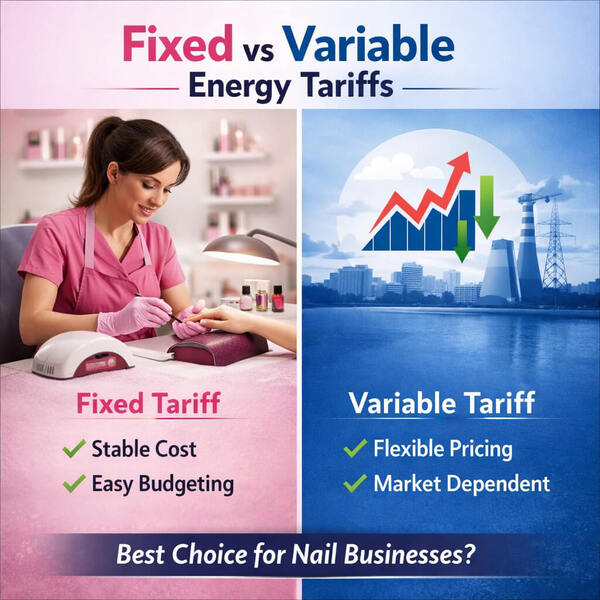
Fixed vs. Variable Energy Tariffs for Nail Technician Companies: Which is Best?
For most nail technician businesses, a fixed-rate energy tariff is the smarter and more reliable choice — and here’s exactly why.
Running a nail technician business means managing back-to-back appointments, keeping a precise and professional environment, maintaining specialist equipment, and watching every overhead cost with a careful eye. Energy bills might not be the first expense that comes to mind — but choosing the wrong tariff can quietly eat into your profit margins every single month. Understanding the difference between fixed and variable energy tariffs is one of the simplest and most impactful steps you can take to bring more certainty to what your business costs to run.
The Two Main Energy Tariff Types — Explained Simply
Fixed-Rate Tariff
With a fixed-rate tariff, the price you pay per unit of energy (kWh) is locked in for the duration of your contract — typically 12, 24, or 36 months. Your bill may still vary slightly depending on how much energy you use, but the unit rate itself won’t change regardless of what’s happening in the wider energy market. This means no surprises, no sudden spikes, and consistent pricing you can plan around.
Variable-Rate Tariff
A variable-rate tariff moves in line with the wholesale energy market. Prices can rise or fall — sometimes with very little notice. When energy prices drop, you could benefit from lower bills. But when prices spike, as they have done dramatically in recent years, your costs can increase significantly with very little warning.
Fixed vs. Variable Energy Tariffs for Nail Technician Companies: Side-by-Side Comparison
| Feature | Fixed-Rate Tariff | Variable-Rate Tariff |
|---|---|---|
| Price Stability | Locked in for contract term | Changes with the market |
| Budget Planning | Easy — predictable monthly cost | Difficult — bills can vary widely |
| Market Savings | Not available | Possible when prices drop |
| Exit Fees | Usually applies | Often none |
| Best For | Stability-focused businesses | Risk-tolerant, active switchers |
Why Fixed-Rate Tariffs Suit Most Nail Technician Businesses
1. Predictable Costs = Better Budgeting
A nail technician business can see income shift significantly from week to week — peak periods around weddings, holidays, and festive seasons sit alongside quieter mid-week slots and unpredictable cancellations. The last thing you need on top of that variability is an energy bill that fluctuates just as unpredictably. A fixed tariff gives you one stable, known cost you can build your monthly budget around with complete confidence, making it far easier to protect your margins throughout the year.
2. Protection From Market Volatility
The wholesale energy market is notoriously volatile. Geopolitical events, seasonal demand shifts, and supply disruptions can cause prices to spike rapidly. A fixed-rate contract insulates your business from these external shocks — meaning your bottom line stays protected even when the wider market turns against you. For a business where margins are already carefully managed, that protection is genuinely valuable.
3. Focus on Growing Your Business
Constantly monitoring energy prices and switching suppliers to chase lower variable rates takes time and mental energy you simply don’t have when you’re running a full appointment book and managing client relationships. A fixed tariff removes that distraction entirely, freeing you to focus on what actually drives revenue — delivering exceptional results, building a loyal client base, and growing your reputation.
4. Easier Financial Planning for Investment
Whether you’re planning to invest in a new UV/LED lamp station, upgrade your ventilation system, expand to a larger salon space, or take on an additional technician, knowing your fixed overheads makes financial planning far more reliable. Lenders and accountants respond much more positively to businesses that can demonstrate consistent and controlled operating costs.
When a Variable Tariff Might Still Be Worth Considering
Variable tariffs aren’t always the wrong choice. If wholesale energy prices are currently high and forecasted to drop significantly, locking into a fixed deal could mean overpaying relative to where the market moves. However, predicting energy markets is notoriously difficult — even professional analysts get it wrong regularly.
Variable tariffs can also make sense if your business is going through a period of change — perhaps you’re planning to relocate your salon, move to a home studio setup, or restructure in the near term and don’t want to be tied into a lengthy contract. Just make sure you’re actively monitoring prices and ready to act quickly if costs begin to rise.
Practical Steps to Choose the Right Tariff
- Review your last 3–6 months of energy bills to understand your typical consumption across busy and quiet trading periods.
- Identify your main energy draws — UV/LED curing lamps, nail drills, extraction fans, salon lighting, heating, and any sterilisation equipment.
- Compare multiple suppliers — don’t assume your current provider is still offering the most competitive deal available.
- Pay close attention to contract length, unit rates, standing charges, and any exit fees before committing to anything.
- Ask about green energy options if sustainability matters to your brand — an increasing number of clients actively favour businesses that demonstrate environmentally responsible practices.
- Set a calendar reminder before your contract ends so you can reassess and switch before rolling onto a more expensive out-of-contract rate.
Key Energy Tips Specific to Nail Technician Businesses
UV/LED Curing Lamps: Curing lamps running back-to-back throughout the day are one of the most consistent energy draws in any nail salon. Modern LED curing lamps are significantly more energy-efficient than older UV models — upgrading gradually can reduce your electricity consumption meaningfully over time while also cutting curing times and improving client throughput.
Nail Drills & Equipment: Professional e-files and nail drills left plugged in and on standby between appointments still draw a continuous load. Making it standard practice to switch equipment off fully at the socket between clients — and entirely at the end of the day — costs nothing and reduces your bill immediately.
Extraction & Ventilation: A high-quality nail dust and fume extraction system is non-negotiable for health, safety, and regulatory compliance. However, running extraction at full power during quieter periods when fewer stations are active is unnecessary. Variable-speed extraction units allow you to match airflow to actual activity — delivering meaningful energy savings without compromising air quality.
Salon Lighting: Nail technicians require excellent, consistent lighting for precision work — colour accuracy and detail are everything in this profession. Switching entirely to high-quality LED lighting throughout your salon delivers significant energy savings without any compromise on the bright, true-colour light your work demands.
Heating & Climate Control: Keeping your salon at a comfortable temperature for clients sitting still during treatments is important for the client experience. A programmable thermostat ensures you’re not paying to heat an empty salon before your first appointment of the day or after your last client has left.
Sterilisation Equipment: UV sterilisation cabinets and autoclave units running throughout the day add a steady load to your energy consumption. Ensuring these are only switched on when needed — rather than left running from opening to close as a default — is a simple habit that reduces your bill without affecting hygiene standards.
Final Thoughts
For most nail technician business owners, choosing between fixed vs. variable energy tariffs comes down to one honest question: how much financial uncertainty can your business comfortably absorb? With appointment income already subject to seasonal swings and last-minute cancellations, adding unpredictable energy costs into the mix creates unnecessary pressure on margins that are already carefully managed.
The smartest move is to stay proactive — compare deals regularly, understand your consumption patterns across different trading periods, and always switch before your contract rolls over to a default rate.
Ready to find a better energy deal for your nail technician business?
Visit Utility7 to compare energy tariffs tailored for beauty and personal care businesses. It only takes a few minutes to find out if you could be saving — and in a business built on precision and attention to detail, those savings deserve exactly the same care.