
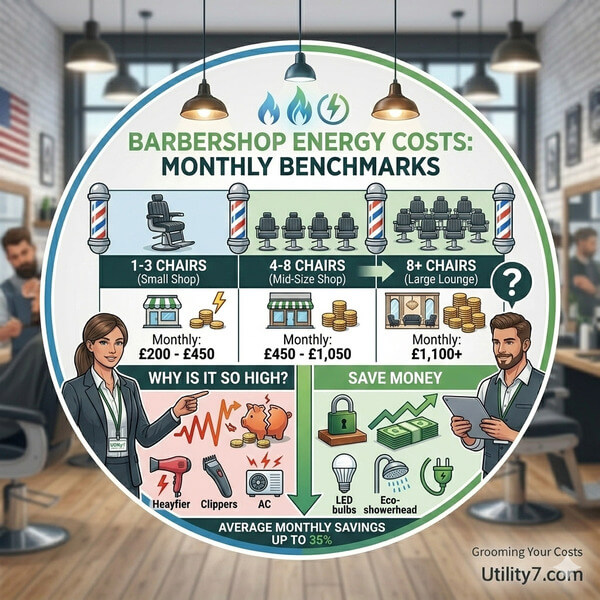
How Much Does Energy Cost Per Month for a Barber’s Business?
A UK barbershop typically spends between £200 and £1,100+ per month on energy — and if you’re not on the right tariff, you’re almost certainly overpaying.
Running a successful barbershop means mastering more than fades and tapers — it means keeping a firm grip on every overhead cost that quietly chips away at your margins. Energy is one of the heaviest and most overlooked of those costs. Understanding exactly where your money goes, what’s normal for a shop your size, and how to bring those bills down is one of the most practical steps you can take to protect your profitability.
Average Monthly Energy Costs for a UK Barbershop
Every barbershop is different, but based on current UK commercial energy rates, most shops fall into one of these brackets:
| Shop Size | Monthly Energy Cost |
|---|---|
| Small (1–3 Chairs) | £200 – £450 per month |
| Mid-Size (4–8 Chairs) | £450 – £1,050 per month |
| Large Grooming Lounge (8+ Chairs) | £1,100+ per month |
On average, a UK barbershop consumes between 7,000 and 10,000 kWh of electricity per year. Electricity is almost always the dominant cost — driven by professional tools, lighting, and climate control running for long hours every day. Gas, where present, is typically limited to space heating and hot water.
What Drives Energy Consumption in a Barbershop?
Unlike a standard retail or office space, a barbershop has a very specific energy profile shaped by the demands of professional grooming. Here’s where your energy is actually going:
1. Styling Tools High-wattage hairdryers (often 2,000W or more), hair straighteners, clippers, and trimmers are in near-constant use throughout every trading day. Across multiple chairs running simultaneously, this adds up faster than most owners realise.
2. Lighting Precision cutting demands excellent visibility. Most barbershops run high-intensity LED or halogen lighting for 10 to 12 hours a day — longer than the majority of small businesses. Lighting can account for a significant portion of your total electricity bill.
3. Hot Water Constant hair washing, hot towel services, and equipment cleaning all draw heavily on your water heating system. If your shop uses an electric water heater, this cost can be surprisingly high — particularly in a busy shop with multiple backwash stations.
4. Climate Control Keeping clients and staff comfortable year-round is non-negotiable. Air conditioning in summer and heating in winter can account for up to 30% of your total energy bill — making it one of the single largest controllable costs in the business.
5. Laundry Towels, gowns, and neck strips need frequent washing throughout the day. Washing machines and tumble dryers running multiple cycles daily are one of the most underestimated energy costs in the grooming industry — a hidden drain that rarely gets the attention it deserves.
How to Reduce Your Barbershop’s Energy Bills
If your monthly costs are sitting above the averages above, these practical steps can make a meaningful difference without disrupting the quality of your service.
Switch to LED Lighting Replacing halogen or older fluorescent bulbs with modern LED alternatives can reduce your lighting energy consumption by up to 75% — with no compromise on the bright, consistent light needed for precision work. It’s one of the fastest-payback upgrades available to any barbershop.
Install Eco Showerheads on Backwash Stations Water-saving showerheads designed for professional backwash units can reduce hot water consumption by 40 to 50%, directly cutting your water heating costs without any noticeable difference to the client experience.
Consider Disposable Towels A growing number of modern barbershops are switching to high-quality biodegradable disposable towels. This single change can eliminate the energy cost of washing machines and tumble dryers entirely — while also saving on water bills and laundry time.
Eliminate Standby Power Draw Clippers on charge, coffee machines on standby, and phone chargers left plugged in all draw a continuous “vampire load” of electricity outside trading hours. Making it standard practice to switch everything off at the plug at the end of each day costs nothing and reduces your bill immediately.
Adjust Your Thermostat Strategically Lowering your shop’s target temperature by just 1°C can reduce your annual heating bill by up to 10%. A programmable thermostat that drops the temperature overnight and between opening hours means you’re never paying to heat an empty shop.
The Fastest Way to Lower Your Monthly Energy Bill
Reducing consumption is important — but the quickest and highest-impact way to lower your monthly energy cost is simply to pay less per unit for the energy you’re already using. Business energy contracts are not price-capped by Ofgem, which means out-of-contract rates can be double — or more — compared to a properly negotiated commercial deal.
As one of the best cheap energy brokers in the UK, Utility7 specializes in helping high-street businesses like barbershops cut through the complexity of the commercial energy market. We compare dozens of suppliers to find a tariff that reflects your specific trading hours, consumption profile, and business size — making sure every penny of your energy spend is working as hard as possible.
Ready to find out how much you could save?
Visit Utility7 at www.utility7.com for a free, no-obligation energy comparison tailored specifically for your barbershop. It takes just a few minutes — and the savings can be significant.