
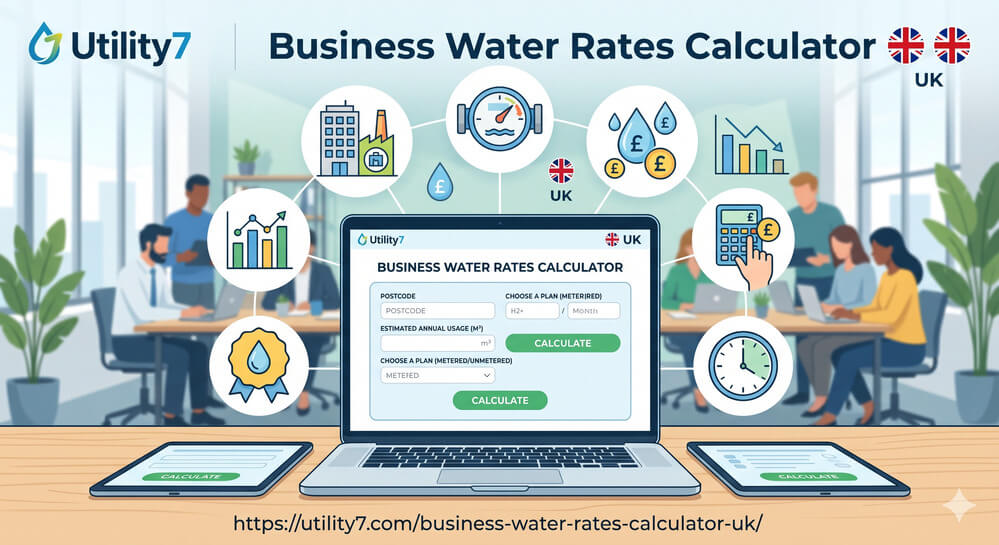
Estimates based on 2026 multipliers (small business: 0.432, standard: 0.48) and regional default tariffs. Actual bills may vary by supplier tariff, meter size, and standing charges.
Business Water Rates Calculator UK
Why Your Business Needs a Water Rates Calculator
Running a business in the UK means keeping a close eye on every bill, and water is no exception. From shops and cafés to offices and warehouses, many companies are now searching for a Business Water Rates Calculator UK to estimate charges quickly. Using this tool can also help you compare overall business utility costs and understand how rateable value, multiplier, and metered usage affect your bills.
In 2026, new rate multipliers and updated tariffs make it even more important to know how your water bill is calculated. This guide will show you how to estimate your business water bill, explain key terms like rateable value and multiplier, and help you use a calculator to compare costs.
Who Benefits Most from a Business Water Calculator?
A business water rates calculator is useful for:
- Companies that want a quick estimate without studying complex supplier PDFs
- Businesses comparing different water suppliers or tariff options
- Finance teams that need to forecast annual costs for budgeting or accounting
- Anyone checking if their current bill looks reasonable
Common users include small offices, retail shops, restaurants, gyms, and light-industrial units. If you pay a commercial water bill in the UK, there is a good chance an online calculator can save you time and help you plan better.
How Business Water Bills Are Calculated in the UK
The Main Components of a Business Water Bill
Business water bills typically include several components:
- Standing charge – a fixed yearly fee for being connected to the water network
- Water usage – charged per cubic metre based on meter readings
- Wastewater/sewerage – covers water that goes back into the drainage system
- Surface water drainage – applies to rainwater that flows from your property into public drains
- Highway drainage – charged in some areas for water that enters roadside drainage
Metered vs Unmetered Business Water
For metered properties, the bill is mainly based on how much water you use. For unmetered or older arrangements, some costs can still be based on rateable value and the multiplier set by your local authority and supplier.
What Is Rateable Value and How Is It Used?
Rateable value is an official estimate of what your property would rent for on the open market. It is used for business rates and sometimes for water-related charges, especially for unmetered or older billing arrangements.
How Rateable Value Affects Your Water Bill
The rateable value appears on your Non-Domestic Rates bill and is decided by government-appointed assessors. It does not change every year, but it can be updated whenever there is a revaluation. For some billing arrangements, your rateable value directly affects your water charge calculation.
Understanding the Multiplier (Poundage)
The multiplier (also called poundage or rate per pound) is the rate applied to your rateable value.
Simple Multiplier Formula Example
The formula is straightforward:
Bill estimate = Rateable Value × Multiplier
For example, if your rateable value is £10,000 and the multiplier is 0.432, the estimate is £4,320. This is why some businesses still see a link between their business rates and water-linked charges.
Changes in Business Water Rates for 2026
2026 Small Business and Standard Multipliers
From 1 April 2026, the business rate multipliers in the UK changed:
- Small business multiplier: 0.432
- Standard multiplier: 0.48 (for other properties)
These updated multipliers affect how much some businesses pay, especially if their charges are still based on rateable value. That is why 2026 is a key year for businesses that want accurate estimates.
When Usage-Based Charges Replace Rateable Value
Since UK water markets opened fully, many businesses are now billed based on actual usage rather than rateable value. For metered properties, you get billed for litres or cubic metres of water used, and supplier tariffs vary by region.
You can compare this with other services like business energy and payment solutions to get a full picture of your overhead costs.
Regional Default Tariffs and Small-Business Rates
A good Business Water Rates Calculator UK must consider:
- Your postcode or region
- Whether your supply is metered or unmetered
- Your annual usage in cubic metres
- Whether sewerage, surface water, and highway drainage need to be included
How to Use a Business Water Rates Calculator
Step-by-Step: Estimating Your Annual Bill
- Step 1 – Enter property details: type of business, postcode or region, and whether the supply is metered or unmetered.
- Step 2 – Add usage information: approximate annual water usage, which you can estimate from previous bills.
- Step 3 – Include rateable value (if relevant): enter the value and the calculator applies the latest multiplier.
- Step 4 – Select tariffs or let the tool choose regional defaults: many tools use default regional tariffs for small businesses.
- Step 5 – See the estimated annual cost: the result usually shows total annual water, sewerage, and drainage charges split by component.
- You can then compare this estimate with your current bill or quotes from suppliers to see if you are overpaying.
Why You Should Use a Calculator in 2026
What You Gain from 2026 Estimates
- Rate multipliers have changed (0.432 small-business, 0.48 standard)
- Supplier tariffs and inflation are pushing businesses to review and compare options
- New businesses starting in 2026 may not have previous bills — a calculator helps them budget
- You can test “what-if” scenarios and compare different suppliers or tariff structures
- Helps explain costs clearly to managers, accountants, or landlords
Common Mistakes When Calculating Business Water Bills
How Calculators Help Avoid Errors
Some common mistakes businesses make:
- Confusing business rates with water charges — both may use rateable value but are separate bills
- Not checking whether your supply is metered or unmetered — this changes the calculation significantly
- Ignoring sewerage and drainage charges — these can add a significant portion to the total bill
Using a clear, up-to-date calculator avoids these mistakes by showing each component separately.
How Utility7 Makes Business Water Easier
What Utility7’s Calculator Offers Businesses
Utility7 offers a Business Water Rates Calculator UK 2026 that helps you:
- Estimate your annual water, sewerage, and drainage costs instantly
- Understand how rateable value and multiplier affect your total
- See a full breakdown for water, sewerage, surface water, and highway drainage
- Compare your current bill with updated 2026 market-based estimates
You can also compare business gas and electricity prices to reduce your total overhead costs further.
No logins. No contracts. Just a fast, clear estimate for 2026.
Perfect for small offices, shops, cafés, warehouses, and multi-site businesses.
Q: What is a Business Water Rates Calculator UK?
A: It is an online tool that estimates your annual business water bill based on your usage, rateable value, region, and the latest 2026 multipliers and supplier tariffs.
Q: How is a business water bill different from a domestic water bill?
A: Business water bills include additional charges such as surface water drainage and highway drainage. They are also calculated differently — often based on metered usage or rateable value — compared to residential bills.
Q: What is the business water rate multiplier for 2026?
A: From 1 April 2026, the small business multiplier is 0.432 and the standard multiplier is 0.48.
Q: Does my business need a water meter?
A: Most businesses benefit from metered billing as it means you only pay for what you use. Unmetered properties may still be billed based on rateable value.
Q: Can I switch my business water supplier?
A: Yes. Since the UK water market opened to competition, businesses in England can switch their water retailer to find a better deal.
Q: How do I find my rateable value?
A: It appears on your Non-Domestic Rates bill. You can also check it on the Valuation Office Agency (VOA) website.
Final Tips for Businesses in 2026
- Always check whether your water is metered or unmetered
- Use your latest Non-Domestic Rates bill to find your rateable value
- Keep an eye on 2026/27 rate multipliers and supplier tariffs when budgeting
- Try Utility7’s calculator to see how estimates match your real-world bills
Or get a free quote from Utility7 today and let our experts help you reduce your total utility costs.