
Quick answer
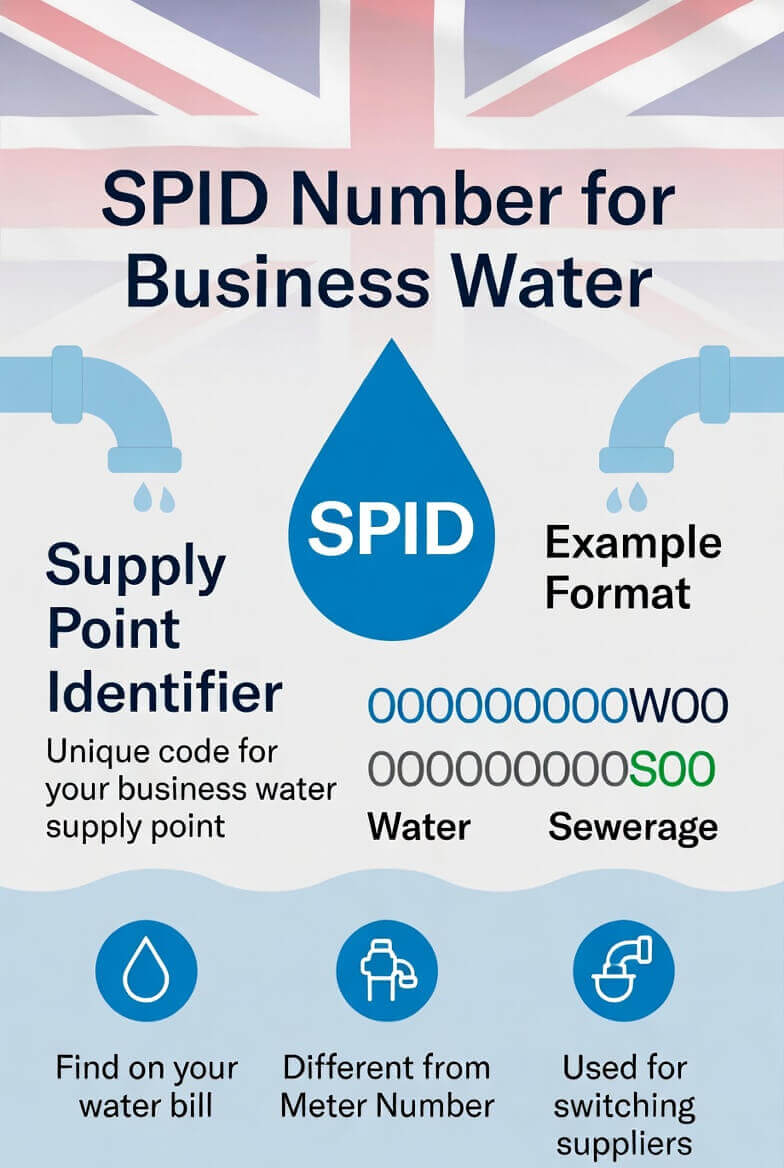
A SPID number, short for Supply Point Identifier, is the unique reference used to identify a business water or wastewater supply point. It helps water retailers, wholesalers and utility consultants confirm the correct premises, meter data, chargeable supply record and switching information. You can usually find it on your latest business water bill.
What Is a SPID Number for Business Water?
If you run a business in the UK and receive a commercial water bill, you may have seen a reference called a SPID number. But what is a SPID number for business water, and why does it matter?
A SPID number stands for Supply Point Identifier. It identifies the water or sewerage supply point connected to a non-household premises, such as a restaurant, takeaway, cafe, shop, office, warehouse, factory, salon, care home or hospitality venue.
In simple terms, the SPID helps confirm the exact supply point linked to your business. This can be important when checking your bill, comparing retailers, reviewing meter details, resolving billing queries or switching your business water contract.
At Utility7, we help UK businesses review utility bills, identify key supply details and compare available options across business water, business gas, business electricity and card machine services. For water, the SPID is one of the most useful details to have before requesting a quote or bill review.
What Does SPID Stand For?
SPID stands for Supply Point Identifier.
It is a unique code linked to a specific commercial water or wastewater supply point. A business may have:
- A water SPID for clean water supply
- A sewerage SPID for wastewater and sewerage services
For many business premises, both references appear on the water bill. The SPID helps confirm the supply point, supply address, meter information and chargeable data linked to the premises.
A SPID is similar in purpose to an MPAN in electricity or an MPRN in gas. It does not simply identify your account with a retailer. It identifies the actual supply point connected to your premises.
Why Was the SPID Number Introduced?
The SPID became especially important after the business water retail market opened. Most non-household customers in England can choose their water retailer, while in Wales the rules are more limited and generally apply to non-household customers using more than 50 million litres of water per year.
Because eligible businesses can choose a retailer, the market needs a reliable way to identify each water and wastewater supply point. That is where the SPID number helps.
It allows different parties to recognise the same premises and supply record, including:
- Your current water retailer
- Your future water retailer
- The regional water wholesaler
- Utility consultants or brokers reviewing your bill
- Market systems used for switching and supply data
Without a SPID, it would be much harder to match the correct supply point to the correct customer, especially for multi-site businesses, landlords, tenants and shared commercial buildings.
Water Retailer vs Water Wholesaler: Why This Matters
To understand why a SPID matters, it helps to understand the difference between a water retailer and a water wholesaler.
| Party | What they usually do | Why the SPID matters |
|---|---|---|
| Water retailer | Sends bills, handles customer service, manages retail services and may deal with meter reading queries. | Uses the SPID to identify the correct site, account, usage and supply data. |
| Water wholesaler | Owns or operates the regional network, including pipes, mains, treatment works and wastewater infrastructure. | Uses the SPID to connect the retailer account to the physical supply point. |
| Utility consultant or broker | Reviews bills, checks supply information and supports comparison or switching where eligible. | Uses the SPID to reduce the risk of quoting the wrong premises or missing key charges. |
Your retailer may change if you switch. The wholesaler responsible for the physical network is usually based on your region. This is why the SPID normally stays connected to the premises, even if the retailer changes.
What Does a SPID Number Look Like?
A SPID number is usually shown as a combination of numbers and letters. For many business water supplies, the reference includes a letter that indicates whether it relates to water or sewerage.
- W is commonly used for water
- S is commonly used for sewerage
Example format:
- Water SPID example: 0000000000W00
- Sewerage SPID example: 0000000000S00
The exact format and label can vary by retailer, so always check your latest business water bill or ask your current retailer to confirm the correct water and sewerage SPIDs.
Where Can You Find Your SPID Number?
The easiest place to find your SPID number is on your latest business water bill. It may appear near:
- Account details
- Supply address
- Meter details
- Tariff details
- Charge breakdown
- Site information
Depending on the retailer, it may be labelled as:
- SPID
- Supply Point Identifier
- Supply ID
- Water SPID
- Sewerage SPID
- Premises ID
If you cannot find it, contact your current water retailer and ask for both the water SPID and sewerage SPID. If you are in a shared building, confirm whether your landlord holds the main account before requesting a switch.
Is a SPID Number the Same as a Meter Number?
No. A SPID number is not the same as a meter number.
A meter number identifies the physical meter installed at your premises. A SPID number identifies the supply point connected to your business water or wastewater service.
This matters because one premises may have:
- One SPID and one meter
- One SPID with multiple meters
- Separate water and sewerage SPIDs
- Multiple SPIDs across different units or buildings
- Old meter records that need checking or updating
A meter number helps measure usage. A SPID helps identify the correct supply record.
Is a SPID Number the Same as an Account Number?
No. Your SPID number is different from your account number.
Your account number is created by your current water retailer for billing and customer service. Your SPID identifies the water or sewerage supply point.
If you switch water retailer, your account number may change, but your SPID usually remains the same while your business stays at the same premises.
Do All Businesses Have a SPID Number?
Most non-household properties with a commercial water or wastewater supply will have at least one SPID number.
This can include:
- Restaurants, takeaways and cafes
- Shops and convenience stores
- Offices and serviced offices
- Warehouses and factories
- Hotels, gyms and leisure venues
- Schools, nurseries and care homes
- Salons, barbers and beauty businesses
- Shopping centre units and industrial estate units
If your business receives a commercial water bill, there is a strong chance the site has a water SPID, a sewerage SPID, or both.
Can One Business Have More Than One SPID?
Yes. A business can have more than one SPID.
This is common when:
- The business has both water and sewerage services
- The business operates from more than one site
- A building has separate units
- A site has multiple water connections
- There are separate metered and unmetered services
- A landlord and tenant arrangement creates complex billing
- A large premises has different operational areas
For example, a restaurant group with 10 branches may have separate water and sewerage SPIDs for each branch. That could mean 20 or more SPIDs across the full business. Multi-site businesses should keep a clear record of every SPID, supply address, meter number, retailer and contract end date.
Why Does a SPID Number Matter for Business Water?
Your SPID number matters because it helps identify the correct supply point. Without it, suppliers, retailers and brokers may struggle to find the right premises, especially where addresses are similar or the business operates from shared commercial property.
Important
A SPID is not just an admin reference. It is directly connected to billing accuracy, site identification and the reliability of any business water comparison.
Your SPID number can help with:
- Comparing business water retailers
- Switching business water contracts
- Checking bill accuracy
- Identifying the correct meter
- Resolving billing disputes
- Managing multi-site accounts
- Checking sewerage and drainage charges
- Confirming whether a supply is active
- Avoiding quotes for the wrong premises
- Understanding your water market data
Why Do You Need a SPID Number to Compare Business Water Suppliers?
When comparing business water suppliers or retailers, your SPID number helps identify the exact supply point and billing data.
This allows a retailer, broker or consultant to check:
- Current retailer
- Supply address
- Water and sewerage arrangement
- Meter details
- Usage history
- Wholesaler region
- Charge structure
- Eligibility to switch
- Current contract position
- Whether site details appear accurate
For businesses that can switch, providing the correct SPID can make the comparison process faster and more accurate.
What Happens If the SPID Number Is Wrong?
If the SPID number is wrong, your business may face delays, inaccurate quotes or billing confusion.
Common problems include:
- Quotes being prepared for the wrong premises
- Incorrect meter details being used
- Wrong supply address being matched
- Sewerage charges being missed or duplicated
- Delays in switching retailer
- Difficulty resolving billing disputes
- Confusion between landlord and tenant supplies
- Incorrect usage data being reviewed
- Old or inactive supplies being quoted
This is why it is important to check your SPID against your latest business water bill before requesting a quote or switching supplier.
How SPID Numbers Help with Billing Accuracy
A SPID number can help identify whether your business water bill is linked to the correct site and supply record.
Billing issues can happen when:
- The wrong meter is linked to the account
- Estimated readings are used for too long
- A closed site remains active in billing records
- Sewerage or drainage charges are applied incorrectly
- A tenant is billed for the landlord supply
- A multi-site account has mixed-up supply records
- A business has moved premises but billing was not updated
By checking your SPID, meter number, supply address and usage, you can spot possible errors more easily. Utility7 can help review your bill and highlight areas that may need further investigation.
SPID Number and Business Water Rates
Your SPID number does not directly set your price. However, it identifies the supply point used to calculate your bill.
A business water bill may include:
- Water standing charge
- Water usage charge
- Sewerage or wastewater charge
- Surface water drainage
- Highway drainage
- Meter-related charges
- Trade effluent charges, if applicable
- Retailer service charges
- Regional wholesale charges
If you are unsure whether your charges look right, use Utility7 content around business water rates and send the latest full bill for review.
SPID Number for Metered vs Unmetered Business Water
A SPID can apply whether your business water supply is metered or unmetered.
For a metered supply, the bill is mainly based on actual or estimated water usage measured in cubic metres. For an unmetered supply, some charges may be based on rateable value or other charging assumptions.
In both cases, the SPID identifies the supply point. However, the billing data connected to that SPID may differ depending on whether a meter is attached.
If your bill looks unusually high, check:
- Whether the SPID matches your premises
- Whether the meter number is correct
- Whether the meter reading is actual or estimated
- Whether the usage pattern looks realistic
- Whether sewerage and drainage charges are correct
SPID Number for Restaurants, Cafes and Takeaways
Restaurants, cafes and takeaways often use more water than standard offices because of cooking, dishwashing, cleaning, customer toilets, staff facilities, food preparation and equipment cleaning.
For hospitality businesses, a wrong SPID or incorrect meter record can create serious billing confusion. If a restaurant is billed using the wrong meter or an old estimated reading, it may overpay without realising. A SPID check helps confirm whether the supply record matches the correct site.
Hospitality businesses should also review their wider utility costs. Utility7 has a useful guide on average utility bills for a cafe in the UK.
SPID Number for Landlords, Tenants and Shared Buildings
SPID issues are common in shared commercial buildings, including shopping centres, office blocks, serviced offices, industrial estates, shared kitchens, multi-let retail units and landlord-managed premises.
In some cases, the landlord may hold the main water account and recharge tenants separately. In other cases, each tenant may have its own direct water supply and SPID.
Before switching supplier or querying a bill, confirm:
- Who is responsible for the water account
- Whether the business has a direct supply
- Whether the SPID belongs to your unit
- Whether the meter serves only your premises
- Whether the lease includes water charges
- Whether the landlord recharges water separately
This can prevent confusion and reduce the risk of switching or reviewing the wrong supply.
SPID Number for Multi-Site Businesses
For multi-site businesses, SPID management is extremely important. Each site may have different SPID numbers, meter numbers, retailers, contract end dates, usage levels, standing charges, drainage charges and billing arrangements.
A simple SPID register can help finance teams manage water more effectively. A useful SPID register should include:
- Site name
- Full supply address
- Water SPID
- Sewerage SPID
- Meter number
- Current retailer
- Wholesaler region
- Annual consumption
- Contract end date
- Notes on disputes or billing issues
Utility7 can support businesses that want to review water alongside gas, electricity and other utility costs.
Common SPID Mistakes Businesses Make
Many businesses only look at the total amount due on their water bill. They do not check the SPID or supply information.
Common mistakes include:
- Confusing SPID with meter number
- Confusing SPID with account number
- Sending only the first page of the bill for review
- Missing the sewerage SPID
- Using an old bill after moving premises
- Assuming all branches have the same SPID
- Ignoring estimated meter readings
- Not checking the supply address
- Not checking whether the account is still in contract
- Not reviewing water because it looks smaller than gas or electricity
These mistakes can delay quotes, reduce accuracy and make switching harder.
How to Check Your SPID Before Requesting a Quote
Before requesting a business water quote, check the following:
- ☐ Is the SPID visible on your latest bill?
- ☐ Does the supply address match your premises?
- ☐ Is there a separate water SPID and sewerage SPID?
- ☐ Does the meter number match the physical meter?
- ☐ Are the readings actual or estimated?
- ☐ Is the business name correct?
- ☐ Is the account still in contract?
- ☐ Are any sites missing from a multi-site account?
- ☐ Are drainage charges included?
- ☐ Are there any unusual charges or adjustments?
This information helps Utility7 review your bill more accurately.
What Information Do You Need to Switch Business Water Suppliers?
To compare or switch business water supplier, it is useful to have:
- Latest business water bill
- Water SPID number
- Sewerage SPID number
- Business name
- Supply address
- Billing address
- Meter number
- Recent meter reading
- Annual consumption
- Current retailer
- Contract end date
- Any outstanding billing dispute
If you are setting up utilities for a new premises, you may also find this utility setup checklist for new UK businesses helpful.
Having the right information ready can reduce delays and improve quote accuracy.
How Long Does Business Water Switching Take?
Business water switching time can vary depending on supplier, site data, contract status and whether there are any billing issues. Open Water says that, once an eligible business has decided to switch, the process should take no more than one month to complete.
The process is usually smoother when:
- The SPID is correct
- The account is not blocked by a dispute
- The contract end date is clear
- Meter data is accurate
- The supply address is correct
- The customer has provided the latest full bill
Utility7 can help review the information before a switch is progressed.
Ready to check your water bill?
Send your latest full business water bill to Utility7. The team can help identify your SPID number, review your charges and compare available business water options for your premises. Savings are not guaranteed and depend on your usage, location, contract terms and available supplier offers.
Can You Switch Business Water Supplier Without a SPID?
It may be difficult to switch without a SPID because the retailer needs to identify the correct supply point.
If you do not know your SPID, you can:
- Check your latest water bill
- Ask your current retailer
- Check whether your landlord holds the account
- Ask a utility consultant to help identify it from your bill
- Review previous water contract documents
The fastest option is usually to provide your latest full business water bill.
How Utility7 Can Help with Your Business Water Bill
Business water costs are often overlooked, but they can still affect your monthly overheads. Utility7 helps businesses review water alongside other key utilities.
Utility7 can help you:
- Review your current business water bill
- Identify your SPID number
- Check your water and sewerage SPIDs
- Understand your current charges
- Compare available business water options
- Review standing charges and usage charges
- Check whether your site details appear correct
- Support a smoother switching process
- Review water alongside gas and electricity
- Reduce the time spent dealing with suppliers
You can also explore Utility7’s wider business utility services for gas, electricity, water and card payment support.
Example: How a SPID Number Works
Imagine you run a restaurant in Birmingham.
Your premises may have:
- A water SPID for clean water supply
- A sewerage SPID for wastewater services
- A meter number attached to the physical water meter
- A retailer that sends your bill
- A regional wholesaler responsible for the network
When you ask Utility7 to review your bill, the SPID helps identify the correct supply point. This reduces the risk of reviewing the wrong meter, missing sewerage charges or quoting the wrong premises. For restaurants and takeaways, this is especially important because water usage can be higher than many other small businesses.
Quick SPID Checklist for Business Owners
- ☐ Latest full bill is available
- ☐ Water SPID is visible
- ☐ Sewerage SPID is visible, if applicable
- ☐ Supply address is correct
- ☐ Meter number is shown
- ☐ Meter reading is not unusually old
- ☐ Usage looks realistic
- ☐ Contract end date is known
- ☐ Current retailer is shown
- ☐ Any dispute or issue is noted
This helps Utility7 review your bill faster and more accurately.
Frequently Asked Questions
What is a SPID number for business water?
A SPID number for business water is a Supply Point Identifier. It is a unique reference used to identify the water or wastewater supply point connected to a business premises.
What does SPID stand for?
SPID stands for Supply Point Identifier.
Where can I find my business water SPID number?
You can usually find your SPID number on your latest business water bill. It may be shown as SPID, Supply Point Identifier, Supply ID, Water SPID or Sewerage SPID.
Do I have both a water SPID and a sewerage SPID?
Many businesses have both. The water SPID relates to clean water supply, while the sewerage SPID relates to wastewater or sewerage services.
Is my SPID number the same as my meter number?
No. A meter number identifies the physical water meter. A SPID number identifies the water or wastewater supply point.
Is my SPID number the same as my account number?
No. Your account number is created by your current water retailer. Your SPID identifies the supply point connected to the premises.
Can my SPID number change?
Your SPID normally stays linked to the same premises. If your business moves to a different premises, the new site will usually have a different SPID.
Do I need a SPID number to switch business water supplier?
It is highly useful and often required because it helps identify your exact supply point and prepare an accurate quote.
Can one premises have more than one SPID?
Yes. A premises may have one SPID for water and another for sewerage. Larger or more complex sites may have multiple SPIDs.
Can Utility7 help me find my SPID number?
Yes. Send your latest business water bill to Utility7, and the team can help identify your SPID number and review your water charges.
Call to action
Want to check whether your business water bill is accurate? Send your latest water bill to Utility7. Our team can help identify your SPID number, review your charges and compare available business water options for your premises.
Final Thoughts
A SPID number may look like a small reference on your water bill, but it plays an important role in business water billing, supplier comparison and switching.
If you are asking, “What is a SPID number for business water?”, the simple answer is this: a SPID number is the unique reference that identifies your business water or wastewater supply point.
Before comparing suppliers or switching your business water contract, always check your latest bill and make sure your SPID details are correct.
For wider cost control, you can also compare business electricity, business gas and card machine services with Utility7.
Methodology and Source Notes for the Article
This article has been written using Utility7 service context and publicly available business water market guidance. It avoids guaranteed saving claims and uses cautious wording around switching eligibility, timelines and supplier availability.