Quick answer
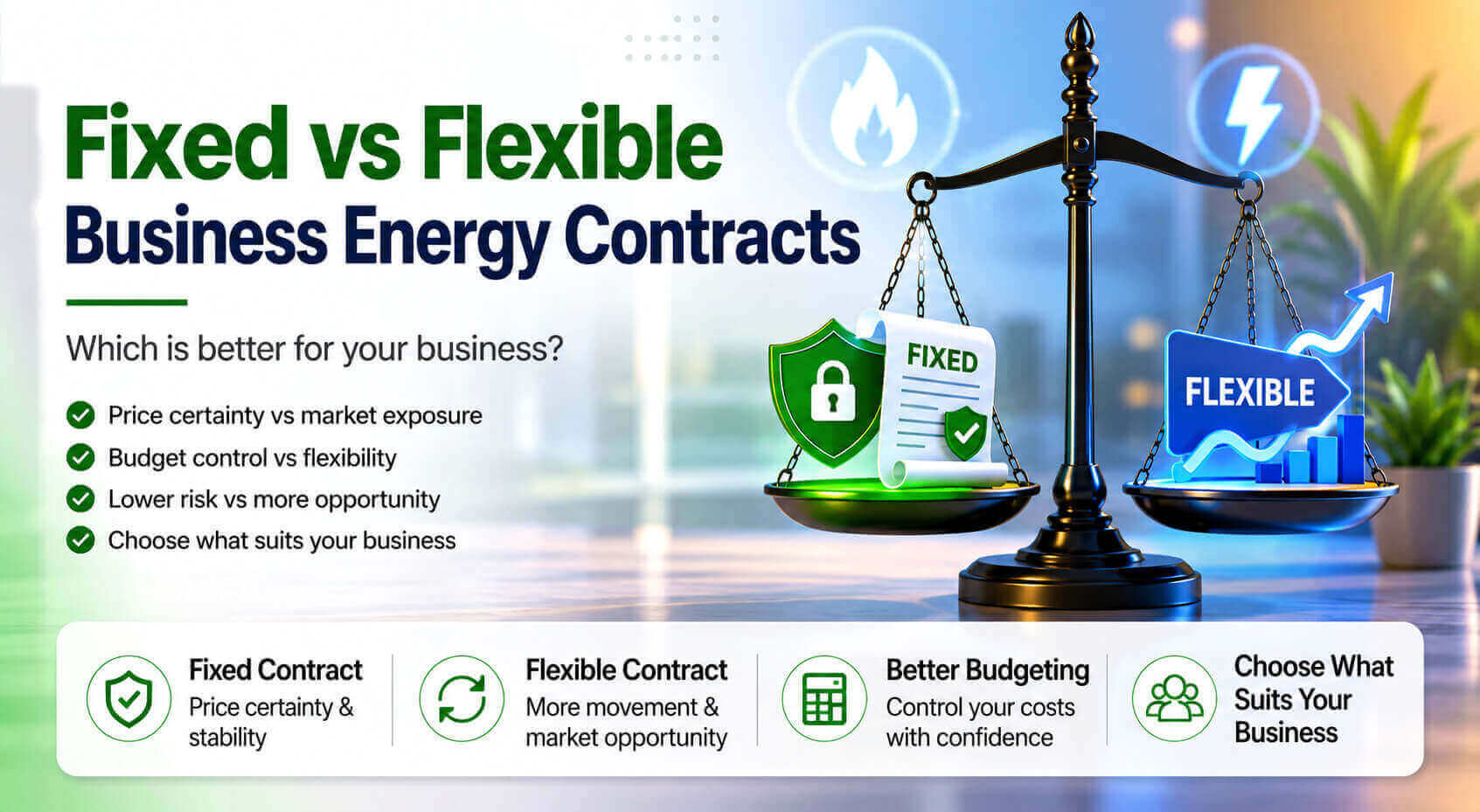
A fixed business energy contract usually gives your business more price certainty because your agreed unit rates are fixed for a set period. A flexible business energy contract may give more movement with the market, but it can also expose your business to price changes. The right choice depends on your usage, risk level, renewal date, cashflow, business size and how much control you want over your energy costs.
Contents
- What Is a Fixed Business Energy Contract?
- What Is a Flexible Business Energy Contract?
- Fixed vs Flexible Business Energy Contracts: Main Difference
- How Fixed Business Energy Contracts Work
- How Flexible Business Energy Contracts Work
- Which Contract Is Cheaper?
- Pros and Cons of Fixed and Flexible Contracts
- Which Businesses Should Choose Fixed or Flexible?
- Fixed vs Flexible Energy Contracts for Restaurants, Cafes and Takeaways
- Fixed vs Flexible Contracts for Multi-Site Businesses
- Common Mistakes Businesses Make
- Quick Checklist Before Choosing a Contract
- How Utility7 Can Help
- Frequently Asked Questions
- Final Thoughts
What Is a Fixed Business Energy Contract?
A fixed business energy contract is an agreement where your business fixes its energy rates for a set period. This usually means the agreed unit rate per kWh and standing charge are set for the contract term.
In simple terms, a fixed contract gives your business more certainty. If wholesale energy prices increase during the fixed term, your agreed rates usually stay the same. However, your total bill can still change depending on how much gas or electricity your business uses.
Fixed contracts are common for business gas and business electricity. Many restaurants, takeaways, cafes, shops, salons, offices, warehouses and care businesses prefer fixed contracts because they make budgeting easier.
Important
A fixed business energy contract does not normally mean your monthly bill will be the same every month. It usually means your agreed rates are fixed. Your total cost still depends on usage, meter readings, VAT and any contract-specific charges.
What Is a Flexible Business Energy Contract?
A flexible business energy contract is a broader term. It can describe contracts where some or all of the energy price can move with the market, or where the customer has more flexibility over purchasing, renewal or switching arrangements.
For smaller businesses, a flexible contract may sometimes mean a variable or rolling tariff where prices can change. For larger businesses, flexible energy procurement can be more advanced, allowing energy to be purchased in stages rather than fixed in one single transaction.
Flexible contracts may suit businesses that are comfortable with market movement, have strong energy usage data, or have a finance team that can monitor costs regularly. They can also suit larger users that want to take advantage of market dips, but they carry more price risk if the market moves upward.
Fixed vs Flexible Business Energy Contracts: Main Difference
The main difference is price certainty versus market exposure.
| Feature | Fixed Contract | Flexible Contract |
|---|---|---|
| Price certainty | Usually higher | Usually lower, depending on contract type |
| Market exposure | Lower | Higher |
| Budget planning | Easier to forecast | Can be harder to forecast |
| Potential benefit | Protection from future price rises | May benefit if market prices fall |
| Risk level | Usually lower | Usually higher |
| Best suited for | SMEs wanting stability | Businesses able to manage price movement |
How Fixed Business Energy Contracts Work
With a fixed contract, your supplier agrees a price structure for a set term. This could be 12 months, 24 months, 36 months or another period depending on the supplier, market conditions and your business profile.
A fixed business energy quote will usually consider:
- Your business postcode and supply address
- Your meter type
- Your annual gas or electricity usage
- Your current supplier
- Your contract end date
- Your credit profile
- Market prices at the time of quote
- Whether the quote includes or passes through certain charges
Once agreed, the fixed contract normally runs until the end date. If you leave early, there may be termination fees or restrictions depending on the supplier and contract terms.
How Flexible Business Energy Contracts Work
Flexible business energy contracts can work in different ways. This is why it is important to check the wording carefully before agreeing.
Common flexible arrangements may include:
- Variable tariffs: your rates may change depending on supplier pricing and market conditions.
- Rolling contracts: the contract continues until you switch or agree a new deal, subject to the terms.
- Pass-through tariffs: some charges may move separately instead of being fully fixed.
- Flexible procurement: larger businesses may buy energy in stages to manage market timing.
- Blend and extend options: some suppliers may offer a revised rate by extending the contract term.
A flexible contract can offer opportunity, but it should not be chosen only because it sounds cheaper. Your business needs to understand what can change, when it can change and how those changes may affect the bill.
Which Contract Is Cheaper?
There is no single answer. A fixed contract may be cheaper if market prices rise after you sign. A flexible contract may be cheaper if market prices fall and your contract allows your business to benefit from that movement.
However, business energy should not be judged by the headline unit rate alone. You should review the full cost and the full contract terms.
When comparing fixed vs flexible business energy contracts, check:
- Unit rate per kWh
- Standing charge
- Contract length
- Renewal terms
- Exit fees or termination rules
- Pass-through charges
- Non-commodity charges
- Payment method
- Estimated annual cost
- Whether the quote is based on actual or estimated usage
Practical tip
Do not choose a business energy contract only because the unit rate looks low. A contract with a lower unit rate but higher standing charge, pass-through exposure or unsuitable terms may not be the best option for your business.
Pros and Cons of Fixed and Flexible Contracts
Fixed Business Energy Contract: Advantages
- Better budget certainty
- Protection if market prices rise
- Easier for monthly forecasting
- Often simpler for small businesses to understand
- Useful for businesses with tight cashflow
- Can reduce the need to monitor the market constantly
Fixed Business Energy Contract: Disadvantages
- You may not benefit if market prices fall
- Leaving early may involve fees or restrictions
- Longer contracts can become expensive if agreed at the wrong time
- Some charges may still vary depending on contract structure
- You still need to track your renewal date carefully
Flexible Business Energy Contract: Advantages
- May benefit if wholesale prices fall
- Can suit businesses with active energy management
- May offer more purchasing control for larger users
- Can be useful when market timing is uncertain
- May avoid locking into a high fixed rate for too long
Flexible Business Energy Contract: Disadvantages
- Prices can increase
- Budgeting may be harder
- Terms can be more complex
- Requires closer monitoring
- May not suit businesses with low tolerance for risk
- Unexpected cost changes can affect cashflow
Which Businesses Should Choose Fixed or Flexible?
The right contract depends on your business. A fixed contract is often suitable for smaller and medium-sized businesses that need stable costs. A flexible contract may suit businesses with higher usage, stronger forecasting and a willingness to accept market movement.
| Business Type | Likely Suitable Option | Why |
|---|---|---|
| Small shop | Fixed | Usually needs predictable monthly overheads |
| Restaurant or takeaway | Fixed or carefully reviewed flexible | High usage means small rate changes can matter |
| Office | Fixed | Easier for simple budget control |
| Warehouse | Depends on usage pattern | Energy demand may vary by operation |
| Multi-site business | Fixed, flexible or mixed approach | Different sites may have different renewal dates and usage levels |
| Large energy user | Flexible may be considered | Larger users may have more scope for active procurement |
Fixed vs Flexible Energy Contracts for Restaurants, Cafes and Takeaways
Restaurants, cafes and takeaways often use more energy than many standard office-based businesses. Cooking equipment, refrigeration, lighting, heating, hot water, dishwashing, extraction systems and long opening hours can all increase usage.
For hospitality businesses, a fixed contract can be useful because it gives more cost certainty. This can help when planning menu pricing, staff costs, rent, card machine fees, business rates and other overheads.
However, a flexible contract may be considered if the business understands the risk and wants more exposure to market changes. This should be reviewed carefully because even a small increase in the unit rate can have a noticeable impact where usage is high.
Hospitality businesses should also review costs across business gas, business electricity, business water and card machine services because savings can sometimes come from more than one area.
Fixed vs Flexible Contracts for Multi-Site Businesses
Multi-site businesses need to be especially careful when comparing fixed and flexible contracts. A business with several branches may have different contract end dates, suppliers, meters and usage levels.
A multi-site business should keep a clear energy register that includes:
- Site name
- Supply address
- MPAN for electricity
- MPRN for gas
- Current supplier
- Contract end date
- Annual usage
- Meter type
- Current unit rate
- Current standing charge
- Renewal notice requirements
Some multi-site businesses may choose fixed contracts across all sites for simplicity. Others may use a mixed approach depending on usage, renewal timing and risk appetite.
Common Mistakes Businesses Make
Many businesses choose an energy contract too quickly, especially when a renewal deadline is close. This can lead to higher costs or unsuitable terms.
Common mistakes include:
- Only comparing the unit rate and ignoring the standing charge
- Not checking the contract end date
- Leaving renewal too late
- Assuming fixed means the total monthly bill cannot change
- Assuming flexible always means cheaper
- Not checking whether charges are fixed or pass-through
- Not reviewing gas and electricity together
- Using estimated annual consumption instead of actual usage
- Not checking exit fees or termination rules
- Agreeing to a long contract without understanding market risk
Quick Checklist Before Choosing a Contract
Before choosing between fixed and flexible business energy contracts, check the following:
- ☐ Do you know your current contract end date?
- ☐ Do you have your latest full business energy bill?
- ☐ Do you know your annual electricity usage?
- ☐ Do you know your annual gas usage, if applicable?
- ☐ Have you checked the unit rate and standing charge?
- ☐ Have you checked whether any charges are pass-through?
- ☐ Have you reviewed the full estimated annual cost?
- ☐ Have you checked early termination rules?
- ☐ Have you compared more than one supplier option?
- ☐ Have you considered your business cashflow and risk level?
This information helps reduce the risk of choosing the wrong energy contract for your business.
How Utility7 Can Help
Utility7 helps UK businesses review energy bills, compare available options and understand contract choices before renewal or switching.
Utility7 can help you:
- Review your current business energy bill
- Check your contract end date
- Compare fixed business energy contract options
- Explain flexible contract considerations
- Review unit rates, standing charges and estimated annual cost
- Check whether your usage details appear realistic
- Support businesses with gas, electricity, water and card machine services
- Reduce time spent dealing with multiple suppliers
Review Your Business Energy Contract
Send your latest business gas or electricity bill to Utility7. Our team can compare available options and explain whether a fixed or flexible contract may suit your business.
Contact Utility7 today
for a free, no-obligation review.
Frequently Asked Questions
What is the difference between fixed and flexible business energy contracts?
A fixed business energy contract usually fixes your agreed unit rates for a set term. A flexible business energy contract may allow some movement with market prices or offer more flexibility in how energy is purchased or renewed.
Is a fixed business energy contract better?
A fixed contract may be better if your business wants price certainty and easier budgeting. It is often suitable for SMEs, hospitality businesses, shops, offices and businesses with tight monthly cashflow.
Is a flexible business energy contract cheaper?
It can be cheaper if market prices fall and your contract allows you to benefit from that fall. However, it can also become more expensive if market prices rise. Flexible contracts should be reviewed carefully before agreement.
Can my bill change on a fixed business energy contract?
Yes. Even if your rates are fixed, your total bill can still change depending on how much energy your business uses, whether readings are estimated or actual, and what charges apply under your contract.
What contract is best for a restaurant or takeaway?
Many restaurants and takeaways prefer fixed contracts because they use gas and electricity heavily and need predictable costs. However, the best option depends on usage, renewal date, market pricing and the business owner’s risk level.
What should I check before signing a business energy contract?
Check the unit rate, standing charge, estimated annual cost, contract length, renewal terms, exit fees, pass-through charges, payment method and whether the quote is based on accurate usage.
Can Utility7 compare fixed and flexible business energy contracts?
Yes. Utility7 can review your latest bill, check key contract details and help compare available business energy options across gas and electricity.
Call to action
Want to check whether your current business energy contract is still suitable? Send your latest bill to Utility7. Our team can help review your gas and electricity options. Savings are not guaranteed and depend on usage, location, contract terms, credit profile and available supplier offers.
Final Thoughts
Fixed vs flexible business energy contracts is not only a question of price. It is a question of certainty, risk, cashflow and how actively your business wants to manage energy costs.
A fixed contract can help protect your business from unexpected price movement and make budgeting easier. A flexible contract can offer more market exposure, but it needs closer monitoring and a clear understanding of the risks.
Before agreeing to any business energy contract, review your latest bill, usage, renewal date and contract terms carefully. For wider cost control, Utility7 can also help with business gas, business electricity, business water and card machine services.
Methodology and Source Notes for the Article
This article has been written using Utility7 service context and publicly available UK business energy guidance. It uses cautious wording around contract choice, savings, switching and supplier availability. Business energy prices and contract terms can change, so businesses should review current quotes and supplier terms before agreeing to a contract.