
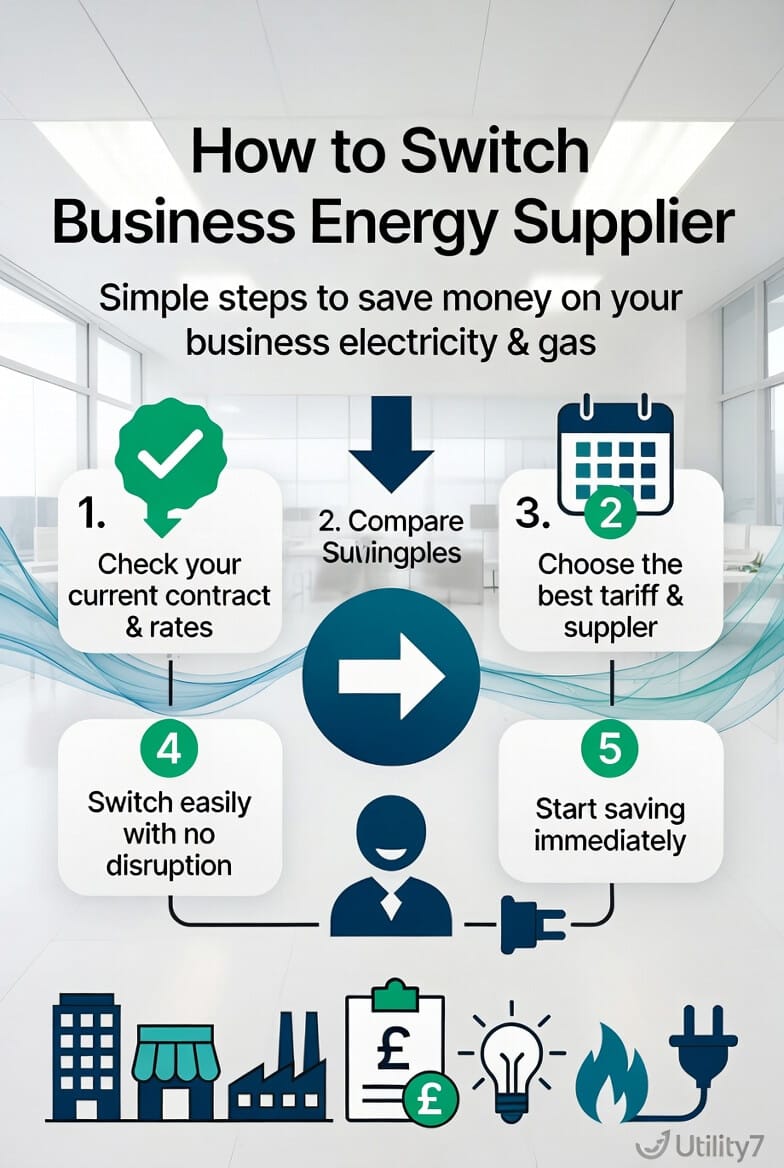
Switch Business Energy Supplier
Business energy bills in the UK have risen sharply over the past few years — and many businesses are still overpaying without realising it. If your contract has expired or your renewal is coming up, switching your business energy supplier could save you anywhere from £500 to £5,000+ per year, depending on your usage.
The good news? The process is straightforward, takes as little as 2–6 weeks, and your supply is never interrupted. Whether you run a small shop, office, or a larger commercial site, this guide walks you through everything you need to know to switch or change your business energy supplier in the UK — including how to switch business electricity suppliers separately from gas — and start saving today.
Get a Free Business Energy Quote (Takes 30 Seconds)
Most UK businesses overpay simply because they don’t compare — this guide fixes that.
Why Switch Business Energy Suppliers?
Most businesses stick with their current supplier out of habit — but loyalty doesn’t pay when it comes to energy. Here’s why switching makes financial sense:
- Rising energy costs: Business energy isn’t protected by a price cap like domestic energy. If you don’t actively manage your contract, you can end up paying 30–60% more than the market rate.
- Better deals are available: The UK energy market is competitive. Dozens of suppliers are actively competing for your business — meaning better rates, better terms, and better service are out there.
- Poor service from your current supplier: Billing errors, slow response times, or lack of dedicated account support are all valid reasons to move on.
- Your contract is ending: The best time to switch is 3–6 months before your contract ends. Miss the window and you risk being rolled onto an expensive default tariff.
The bottom line: switching is one of the fastest ways to cut overheads without changing how you operate.
When Can You Switch Your Business Energy Supplier?
Timing matters. Here’s when you can switch — and when you need to watch out:
Contract end date: Your contract will have a specific end date. This is your primary switching window. Most suppliers allow you to give notice and begin the switch 3–6 months before this date.
Renewal window (typically 30–90 days before expiry): Many suppliers require written notice within a specific window — often 30, 60, or 90 days before the contract ends. Miss this window and your contract may auto-renew, locking you in for another fixed term.
Out-of-contract (deemed rate): If your contract has already ended and you haven’t switched, you’re likely on a “deemed rate” or “out-of-contract rate.” These are almost always significantly higher than a negotiated fixed deal — sometimes double. You can switch at any time from this position with no exit fees.
Exit fees / early termination charges: If you’re mid-contract, switching early may come with a penalty fee. Always check your contract terms before proceeding. In some cases, the savings from switching still outweigh the exit fee — our experts at Utility7 can help you calculate this.
Step-by-Step Process to Switch Business Energy Supplier
Switching is purely administrative — there is no interruption to your gas or electricity supply. Here’s how it works:
Step 1 — Review your current contract
Find your contract end date, your notice period, and check for any early exit fees. This information is usually on your bill or in your original contract paperwork.
Step 2 — Gather your energy details
You’ll need:
- Your MPAN (electricity) or MPRN (gas) — found on your current bill
- Your annual consumption in kWh
- Your current unit rate and standing charge
Step 3 — Compare suppliers
Don’t just accept a renewal quote from your current supplier. Use a business energy broker like Utility7 to compare deals from multiple suppliers — including rates not available directly to the public. You can also read our guide on how business energy brokers work in the UK to understand exactly how brokers negotiate better rates on your behalf. This is where the biggest savings are found.
Compare Business Energy Deals Now
Step 4 — Choose your new tariff
Decide between:
- Fixed-rate: Your unit rate stays the same for the contract term. Great for budget certainty.
- Variable/flexible: Rates can move with the market. Can save money if prices fall, but adds risk.
Step 5 — Sign with your new supplier
Once you’ve chosen, your new supplier handles the switch. You don’t need to contact your old supplier — the new supplier does this on your behalf.
Step 6 — Submit a final meter reading
On the switch date, take a meter reading and submit it to both your old and new supplier. This ensures your final bill is accurate and avoids disputes.
That’s it. No tools, no engineer visits, no downtime.
How Long Does It Take to Switch?
Switching a business energy supplier in the UK typically takes 2 to 6 weeks.
More specifically, from the point of signing your new contract, most switches complete within this window — though the exact timeline depends on your meter type and whether any objections arise.
For electricity, the process tends to be slightly faster. Gas switches can take a little longer due to network coordination.
Common reasons for delays:
- Objections from your current supplier (usually related to an active fixed contract)
- Incorrect meter details submitted
- Outstanding debt on your current account
- Meter not being registered correctly on the national database
Working with an experienced energy broker like Utility7 helps avoid these delays, as we handle the coordination and flag any issues early.
Compare Business Energy Deals Now — Free & No Obligation
Direct Supplier vs Energy Broker — Which Is Better?
| Feature | Going Direct to Supplier | Using Utility7 (Broker) |
|---|---|---|
| Number of options | Limited to 1 supplier | Multiple suppliers compared |
| Pricing | Standard published rates | Negotiated wholesale rates |
| Time investment | High — you do the research | Low — we do it for you |
| Support | Basic customer service | Dedicated expert guidance |
| Best deal guarantee | No | Yes — we compare the market |
| Ongoing management | None | Contract reminders + renewals |
Going direct to a supplier means you only see their rates. An independent broker like Utility7 accesses the broader market and negotiates on your behalf — which typically means a better deal, less time spent, and fewer surprises.
Common Mistakes to Avoid When Switching
These are the mistakes that cost UK businesses thousands of pounds every year:
- Switching too late Leaving it until your contract expires means you miss the window for the best rates. Start comparing 3–6 months before your end date.
- Not comparing multiple deals Taking the first renewal quote you receive — even from your existing supplier — without comparing the market is a common and costly mistake. Always get at least 2–3 quotes.
- Ignoring hidden charges Always check the standing charge, not just the unit rate. Some tariffs look cheap per kWh but have high daily standing charges that add up significantly.
- Missing the auto-renewal clause Many business energy contracts include an auto-renewal clause. If you don’t give notice within the specified window, you’re locked in for another term at whatever rate the supplier sets. Put your renewal date in your calendar now.
- Not checking exit fees before switching mid-contract If you’re in a fixed-term contract, early termination fees can be substantial. Always calculate whether the savings outweigh the cost before switching early. Before signing any new contract, it’s worth following a proper checklist for business energy contracts to make sure you’re not missing anything important.
How Utility7 Helps You Switch Easily
At Utility7, we specialise in helping UK businesses find the right energy deal — quickly, transparently, and without the hassle of doing it all yourself.
Here’s what we do for you:
- Compare multiple suppliers in one place — we work with a wide panel of UK energy suppliers, from the Big Six to specialist commercial providers
- Negotiate better rates — we access wholesale and preferential rates that aren’t available if you go direct
- Handle the switch from start to finish — paperwork, coordination with your old and new supplier, and meter reading reminders
- Save you time — instead of calling around and comparing complex tariffs, you get clear options in a single conversation
- Ongoing support — we monitor your contract and flag renewal windows so you never get stuck on a bad rate again
We’ve helped hundreds of UK businesses reduce their energy bills by up to 30–60% — and we can do the same for you.
Real Example: How a Small Business Saved £2,400 Per Year
A small restaurant in the West Midlands came to Utility7 after their energy bills had nearly doubled. They had been rolled onto a default variable tariff when their fixed contract ended without them noticing.
After reviewing their usage and comparing deals from multiple suppliers, we secured them a 2-year fixed rate that cut their annual energy spend from approximately £8,200 to £5,800 — a saving of £2,400 per year with no interruption to their supply and no exit fee, as their previous contract had already expired.
This is not unusual. Many businesses are sitting on significant savings without realising it. The first step is simply to compare.
Get a Free Business Energy Quote Today
Ready to stop overpaying on your business energy? Here’s how to get started:
Get a Free Quote — tell us your current usage and we’ll compare the market for you
Compare Deals Now — see live rates from multiple UK suppliers side by side
Speak to an Expert — call or WhatsApp us at 079 1368 5973 and we’ll handle everything
Energy prices change daily. Locking in a rate today could save you significantly compared to waiting even a few weeks.
Most businesses overpay because they delay switching — don’t miss your window.
Email: info@utility7.com
Phone/WhatsApp: 079 1368 5973
HQ, The Quadrant, 3 Warwick Rd, Coventry, UK, CV1 2DY
Compare Business Energy Deals Now
Frequently Asked Questions
Can I switch business energy suppliers anytime?
Yes — if you’re out of contract or on a deemed/variable rate, you can switch immediately with no penalties. If you’re in a fixed-term contract, check your exit clause first, as early termination fees may apply.
Is switching business energy suppliers free?
Switching itself is free. Using an energy broker like Utility7 is also free to you — brokers are paid a commission by the supplier, not the customer. Always confirm this upfront with any broker you use.
Will my energy supply be interrupted when I switch?
No. Switching suppliers is entirely administrative. The same pipes and cables deliver your energy — only the billing company changes. There is zero downtime or interruption to your supply.
What information do I need to switch business energy suppliers?
You’ll need: your MPAN (electricity) or MPRN (gas) from your current bill, your annual consumption in kWh, your current contract end date, and your business address. A recent bill covers most of this in one place.
How do I know if I’m getting a good deal?
The only way to know is to compare. If you haven’t compared your rate against the market in the last 12 months, there’s a good chance you’re overpaying. Contact Utility7 for a free market comparison.
What is an auto-renewal clause?
This is a clause in many business energy contracts that automatically renews your contract for another term if you don’t give notice within a specific window (often 30–90 days before expiry). Missing this can lock you in for 1–3 more years at potentially unfavourable rates. Always note your renewal window and act early.
Can I switch business electricity and gas separately?
Yes. Electricity and gas are treated as separate contracts in the UK, so you can switch business electricity supplier and gas supplier independently — and at different times. This can be useful if one contract is ending sooner, or if you find a better deal for one fuel type but not the other.
What happens if I miss my renewal window?
If you miss the notice window your supplier requires, your contract will likely auto-renew for another fixed term — often 1–2 years at whatever rate the supplier sets, which may be higher than the current market. Contact Utility7 as soon as you realise, as in some cases we can still negotiate an exit or help you plan for the next available switching opportunity.