Quick answer
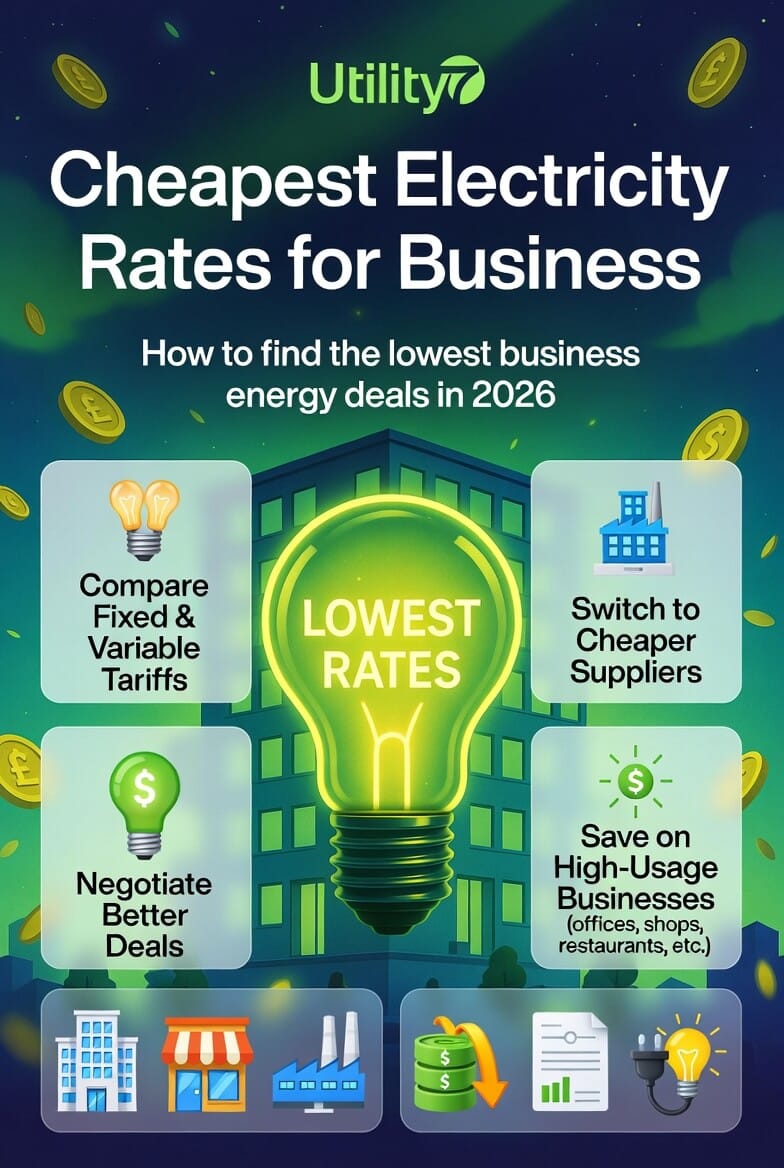
Finding the cheapest business electricity rates UK is not just about choosing the lowest unit rate. Your business should compare the full annual cost, including the unit rate, standing charge, contract length, renewal terms and usage pattern. Utility7 helps UK businesses compare business electricity rates and understand whether a cheaper deal may be available.
Contents
- Cheapest Business Electricity Rates UK: Overview
- What Affects Business Electricity Rates UK?
- Unit Rate vs Standing Charge
- Commercial Electricity Prices UK Explained
- How to Compare Business Electricity Rates
- How to Find Cheap Business Electricity UK
- Which Businesses Need to Compare Electricity Rates?
- Common Mistakes When Comparing Business Electricity
- How Utility7 Can Help
- Frequently Asked Questions
- Final Thoughts
Cheapest Business Electricity Rates UK: Overview
Electricity is one of the most important running costs for UK businesses. Whether you run a restaurant, takeaway, cafe, shop, salon, office, warehouse or care business, your electricity contract can have a direct impact on your monthly cashflow.
Many business owners search for the cheapest business electricity rates UK, but the cheapest-looking quote is not always the best deal. A low unit rate may come with a high standing charge, strict contract terms or charges that make the overall annual cost less attractive.
To make a better decision, your business should compare the full electricity quote, not only the headline price. This includes your usage, contract end date, meter details, supplier options and the estimated annual cost.
Important
Business electricity prices change regularly. Any quote should be checked based on your latest bill, postcode, usage, meter type and contract renewal date. Savings are not guaranteed and depend on supplier availability, usage and contract terms.
What Affects Business Electricity Rates UK?
Business electricity rates UK can vary from one business to another. Two businesses on the same street may receive different quotes because suppliers consider several factors before offering a rate.
Key factors include:
- Your business postcode and supply address
- Your annual electricity usage
- Your meter type
- Your current supplier
- Your current contract end date
- Your payment method
- Your business credit profile
- Market conditions at the time of quoting
- Contract length, such as 12, 24 or 36 months
- Whether your quote includes fixed or pass-through charges
This is why it is important to compare business electricity rates properly before agreeing to a new contract.
Unit Rate vs Standing Charge
When comparing cheap business electricity UK options, many businesses only look at the unit rate. The unit rate is important, but it is not the only cost.
A business electricity bill usually includes:
- Unit rate: the price you pay for each kWh of electricity used.
- Standing charge: a daily fixed charge for keeping your electricity supply connected.
- VAT: charged depending on your business and usage circumstances.
- Climate Change Levy: may apply to business electricity usage.
- Other charges: some contracts may include additional or pass-through charges.
| Cost Type | Why It Matters |
|---|---|
| Unit rate | Important for high-usage businesses because every kWh affects the final bill. |
| Standing charge | Important for lower-usage businesses because it applies every day, even when usage is low. |
| Contract length | Longer contracts may give budget certainty, but shorter contracts may offer more flexibility. |
| Estimated annual cost | This is often more useful than comparing the unit rate alone. |
Commercial Electricity Prices UK Explained
Commercial electricity prices UK are different from domestic electricity prices. Businesses do not usually receive the same type of protected tariff structure as household customers, and quotes can be based on business-specific details.
Your business electricity price can depend on how much power your business uses, when you use it, your meter type and the contract available at the time. For example, a restaurant using ovens, refrigeration and lighting for long hours may have a different electricity profile compared with a small office that operates during standard working hours.
This is why a tailored comparison is important. A quote that looks cheap for one business may not be suitable for another.
How to Compare Business Electricity Rates
To compare business electricity rates properly, you need your latest electricity bill. This helps suppliers and brokers check your current rates, annual usage, meter details and contract end date.
Before comparing quotes, gather:
- Your latest full business electricity bill
- Your MPAN number
- Your business postcode
- Your current supplier name
- Your current contract end date
- Your annual kWh usage
- Your current unit rate and standing charge
- Your business name and supply address
If you do not know your MPAN number, you can usually find it on your electricity bill. It helps identify your electricity supply point and allows quotes to be matched to the correct site.
Practical tip
Start comparing before your current contract ends. Leaving it too late can reduce your options and may result in your business moving onto higher out-of-contract or deemed rates.
How to Find Cheap Business Electricity UK
Finding cheap business electricity UK is not about rushing into the first quote. It is about checking the full cost and making sure the contract suits your business operations.
Here are practical steps:
1. Check your contract end date
Your renewal date is one of the most important details. If you miss it, your business may lose access to better options or be moved onto less favourable rates.
2. Compare the estimated annual cost
Do not compare electricity quotes by unit rate only. A better comparison should include the annual cost based on your estimated usage.
3. Review the standing charge
A quote with a low unit rate and high standing charge may not be the cheapest option for a low-usage business.
4. Understand the contract length
A fixed business electricity contract can help with budget planning, but the right term depends on your risk level and renewal strategy.
5. Use accurate usage data
If the quote is based on estimated usage that is too low, the projected annual cost may look cheaper than reality. Always use your latest annual consumption where possible.
Which Businesses Need to Compare Electricity Rates?
Almost every business using electricity should compare rates before renewal. This is especially important for businesses with high daily usage or multiple electrical systems.
| Business Type | Why Comparison Matters |
|---|---|
| Restaurants and takeaways | Cooking equipment, refrigeration, lighting and long opening hours can increase electricity usage. |
| Cafes | Coffee machines, chillers, lighting and heating can make electricity costs a regular overhead. |
| Retail shops | Lighting, tills, refrigeration and security systems can add to daily electricity use. |
| Offices | Computers, servers, heating, cooling and lighting can make contract choice important. |
| Warehouses | Machinery, lighting and operational hours may create higher consumption patterns. |
Common Mistakes When Comparing Business Electricity
Many businesses want the cheapest business electricity rates UK, but they sometimes make decisions based on incomplete information.
Common mistakes include:
- Only comparing the unit rate
- Ignoring the standing charge
- Not checking the contract end date
- Waiting until the last minute to compare quotes
- Using old or estimated usage figures
- Not checking whether the quote is fixed or variable
- Not reviewing exit fees or renewal terms
- Assuming the cheapest headline price is the best overall contract
- Not comparing enough supplier options
How Utility7 Can Help
Utility7 helps UK businesses review electricity bills, compare available supplier options and understand business electricity contract terms before renewal or switching.
Utility7 can help you:
- Review your latest business electricity bill
- Check your current unit rate and standing charge
- Identify your contract end date
- Compare business electricity rates from available suppliers
- Explain fixed, flexible and renewal options
- Review your estimated annual cost
- Support wider utility comparisons across electricity, gas, water and card machine services
Compare your business electricity rates
Send your latest business electricity bill to Utility7. Our team can help compare available options and explain whether a more suitable electricity contract may be available for your business.
Contact Utility7 today
for a free, no-obligation review.
Frequently Asked Questions
How do I find the cheapest business electricity rates UK?
To find the cheapest business electricity rates UK, compare the unit rate, standing charge, estimated annual cost, contract length and renewal terms. You should use your latest business electricity bill so the comparison is based on accurate usage.
What is cheap business electricity UK?
Cheap business electricity UK usually means a contract that offers a competitive overall annual cost for your specific business usage. It does not always mean the lowest unit rate, because standing charges and contract terms also matter.
Are business electricity rates UK the same for every company?
No. Business electricity rates UK can vary depending on your postcode, usage, meter type, supplier, contract end date, payment method and business profile.
How often should I compare business electricity rates?
You should compare business electricity rates before your current contract ends. It is sensible to start early so you have enough time to review available options and avoid being moved onto higher rates.
What affects commercial electricity prices UK?
Commercial electricity prices UK can be affected by wholesale market movement, network charges, supplier costs, contract length, business usage, meter type, location and payment terms.
Can Utility7 help compare business electricity rates?
Yes. Utility7 can review your latest bill and help compare business electricity rates from available supplier options. The team can explain the unit rate, standing charge, contract length and estimated annual cost.
Final Thoughts
Finding the cheapest business electricity rates UK requires more than a quick look at the unit rate. Your business should compare the full contract, including standing charges, usage, contract length and renewal terms.
The right electricity contract depends on your business type, operating hours, equipment, energy usage and cashflow. A restaurant, office, shop or warehouse may each need a different approach.
As a Business energy broker UK, Utility7 helps businesses review their current electricity costs and compare available options clearly. Utility7 can also support comparisons for business gas, business water and card machine services.
Methodology and Source Notes
This article has been written using Utility7 service context and general UK business energy guidance. It uses cautious wording around prices, savings and supplier availability because business electricity quotes can change regularly. Businesses should review live quotes and supplier terms before agreeing to any contract.