
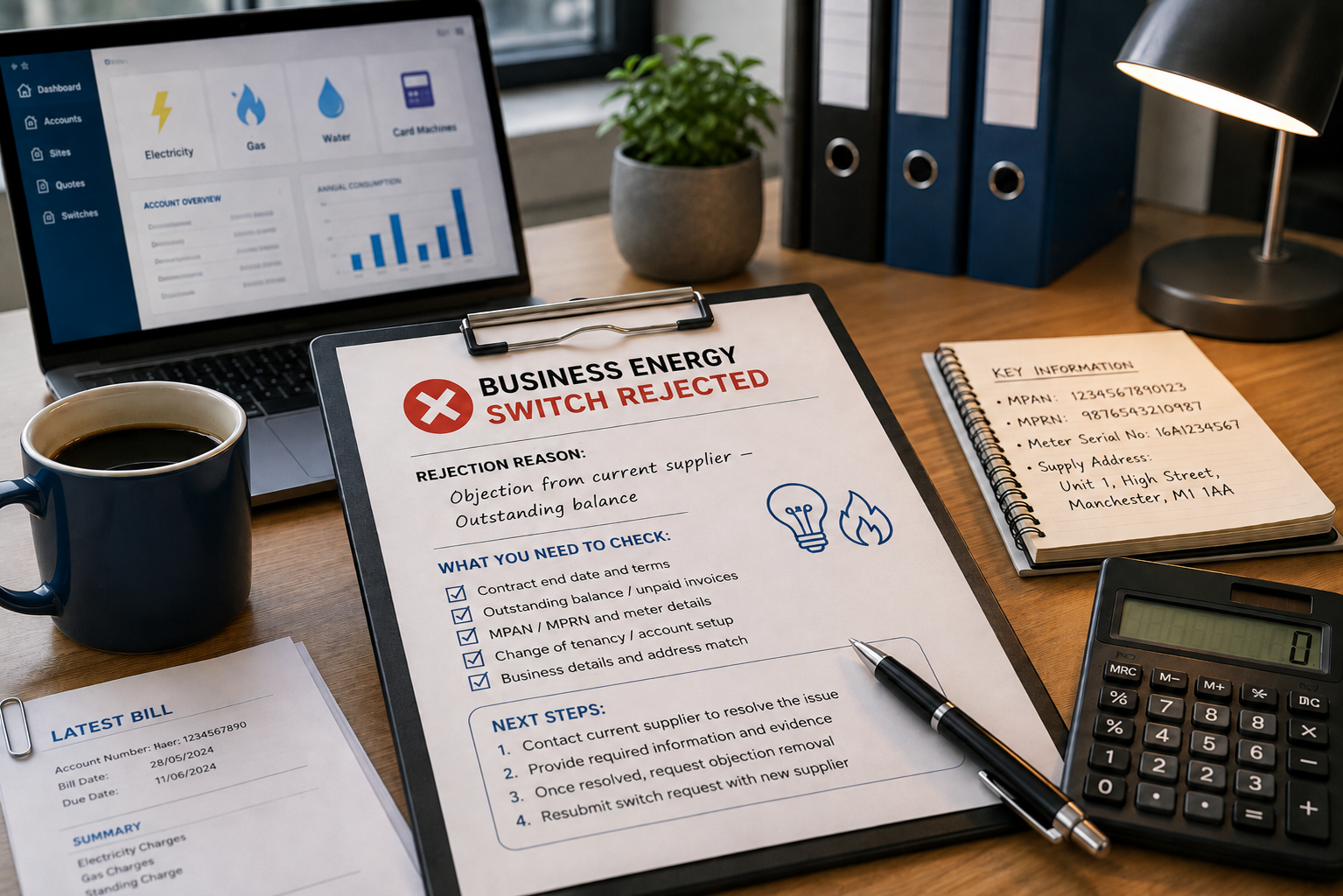
Business Energy Switch Rejected? A blocked or failed supplier transfer can be frustrating, but the first step is to identify whether you are dealing with a formal objection from your current supplier or a separate data, contract or account problem.
For UK businesses, a switch can run into problems when a fixed-term contract is still active, the current supplier relies on a valid contractual right to object, there is an unresolved account balance, or the supply details submitted for the transfer do not match the records held for the premises.
The important point is not to keep submitting the same switch request without understanding the cause. This guide explains seven practical steps to diagnose the issue, organise the evidence and decide what to do next.
Why Was Your Business Energy Switch Rejected?
A Business Energy Switch Rejected message does not always mean the new supplier has refused your business. In some cases, your existing supplier has formally objected to the transfer. In others, the transfer may have failed because key data could not be matched correctly.
Ofgem explains that business energy contracts can run for a fixed term and that most suppliers will not allow a business to switch before the contract ends. Ofgem has also recognised contractual terms and debt as important reasons for non-domestic transfer objections.
Before taking action, check whether you are actually eligible to leave your current agreement. Utility7’s guide to your business energy contract end date can help you understand which date to verify on your bill or contract.
Common Reasons a Business Energy Switch Fails
When a Business Energy Switch Rejected notification arrives, ask for the precise reason rather than assuming the problem is price or credit. The table below separates common contract issues from account and data issues.
| Possible issue | What it may mean | What to check | Practical next step |
|---|---|---|---|
| Fixed-term contract | Your current agreement may not yet permit the transfer. | Contract end date and termination terms. | Confirm the earliest valid switch date. |
| Outstanding balance | Your contract may give the supplier a right to object in certain debt circumstances. | Account balance, invoices and disputed amounts. | Ask what must be resolved for the objection to be removed. |
| Wrong MPAN or MPRN | The new supplier may be trying to register the wrong supply point. | MPAN, MPRN, meter serial number and address. | Correct the supply data before resubmission. |
| Change of tenancy incomplete | The supplier may still have the previous occupier on record. | Occupancy date, lease and opening meter reading. | Complete the account change first. |
| Administrative mismatch | Business name, postcode or account data may not match. | Legal entity, trading name and supply address. | Ask both suppliers to confirm the registration data. |
Business Energy Switch Rejected? 7 Proven Steps to Fix It
1. Ask for the exact rejection or objection reason
Start with your current supplier and the proposed new supplier. Ask whether the transfer was formally objected to or simply failed during registration. Request the reason in writing where possible, including any account reference or objection code they can provide.
If your Business Energy Switch Rejected problem is caused by one specific issue, resolving that issue is usually more useful than immediately starting a completely new comparison.
2. Confirm your contract end date and termination terms
Check the original contract, renewal correspondence and latest bill. Do not rely only on a date entered into a spreadsheet or CRM. Confirm whether you are inside a fixed term, a renewal period, a roll-over arrangement or an out-of-contract position.
For a broader explanation of the switching process, see Utility7’s guide on how to switch business energy supplier. You can also review Ofgem’s business energy contract guidance for independent information.
3. Check outstanding balances and disputed invoices
Review the account ledger rather than looking only at the latest monthly bill. A balance might relate to an older invoice, estimated consumption, a missed payment, a disputed charge or an account adjustment that has not yet been completed.
If debt is given as the reason for a Business Energy Switch Rejected outcome, ask the supplier to identify the amount and the contractual basis for the objection. If you dispute the balance, make that clear in writing and provide the evidence supporting your position.
4. Verify the MPAN, MPRN and meter details
Electricity supplies use an MPAN and gas supplies use an MPRN. These references identify the supply point, so a wrong number can send a switch request to the wrong meter or premises.
- Check the MPAN or MPRN against a recent supplier bill.
- Compare the meter serial number with the physical meter.
- Confirm the full supply address and postcode.
- For multi-site businesses, confirm that each meter point is matched to the correct site.
5. Resolve change-of-tenancy or business-name issues
If you recently took over a restaurant, shop, office, warehouse or other commercial premises, the current supplier may still hold the previous occupier’s details. Give the supplier your occupation date, opening meter reading and any reasonable evidence it requests to establish responsibility for the account.
A Business Energy Switch Rejected case can therefore be an account-registration problem rather than a problem with the energy quote itself. Get the current account correctly established before asking the new supplier to retry.
6. Keep both suppliers working from the same information
Send corrected information to the party that needs it and keep a record of dates, names, emails and reference numbers. If the old supplier says the objection has been removed, ask when the system will reflect that change and tell the new supplier when it is appropriate to resubmit.
Useful record: keep the rejection notice, contract, latest bills, payment evidence, meter photographs, MPAN or MPRN, occupancy documents and supplier correspondence together. This can make follow-up much easier.
7. Retry the switch or use the complaints process
Once the underlying issue is genuinely resolved, ask the new supplier whether the transfer needs to be resubmitted. Do not assume that correcting an account automatically restarts an earlier application.
If you believe a Business Energy Switch Rejected objection is incorrect and the supplier does not resolve it, follow the supplier’s formal complaints process. Utility7’s business energy complaints guide explains how to organise a complaint. Citizens Advice also provides independent guidance on switching business energy suppliers.
How to Reduce the Risk of Another Failed Switch
Once a Business Energy Switch Rejected issue has been resolved, take a few minutes to verify the next submission before it is sent. This is particularly important for multi-site businesses and businesses that have recently changed legal entity, occupier or trading address.
- Use a recent bill to confirm supply numbers and account details.
- Check the contract end date directly with the current supplier if anything is unclear.
- Resolve material account disputes before the planned transfer date where possible.
- Complete any change of tenancy before arranging the new contract.
- Keep written confirmation of important changes and objection removals.
If a switch is accepted, Ofgem says a supplier switch should normally take up to five working days, although a business can ask for a later transfer date. Contract eligibility still needs to be checked before the switch is requested.
How Utility7 Can Help With a Business Energy Switch Rejected Issue
Utility7 helps UK businesses review the information needed for business electricity and gas comparison. If your switch has failed, our team can help you organise key contract, account and meter details before you decide on the next step.
Need Help Reviewing a Failed Business Energy Switch?
Send Utility7 your latest bill and the switch rejection details. We can help you review the key information and understand what may need checking before you try again. No savings or switch outcome can be guaranteed.
Frequently Asked Questions
1. Why was my business energy switch rejected?
A switch may be blocked because your current contract has not reached the point where you can leave, a contractual objection applies, an account balance needs attention, or there is a problem with the supply or account data. Ask both suppliers for the exact reason before taking further action.
2. Can my current supplier stop me switching business energy supplier?
In some circumstances, yes. For non-domestic customers, a supplier may be able to object where the contract contains a valid term allowing it to prevent the transfer in the circumstances that apply. Ask the supplier to explain the contractual reason and what you need to do to resolve it.
3. Can a business switch energy supplier if it owes money?
It depends on the business contract and the circumstances of the debt. Do not assume domestic switching rules apply to a commercial account. Ask your current supplier whether the balance is causing an objection, check the relevant contract term and challenge any amount you believe is incorrect.
4. Can Utility7 fix a rejected business energy switch?
Utility7 cannot guarantee that a supplier will remove an objection or accept a transfer. We can help review your latest bill, contract end date, MPAN or MPRN, usage information and other key details so you are better prepared to speak with the supplier and compare available options.
Final Thoughts
A Business Energy Switch Rejected notification should be treated as a problem to diagnose, not simply a reason to abandon the switch. Find out whether the cause is contractual, financial, data-related or administrative, then deal with that specific issue before resubmitting.
The most useful documents are usually your current contract, latest bills, account balance, MPAN or MPRN, meter details and any written rejection notice. With those details organised, your business can approach the supplier with clearer questions and make a better-informed decision about the next contract.