
Quick answer
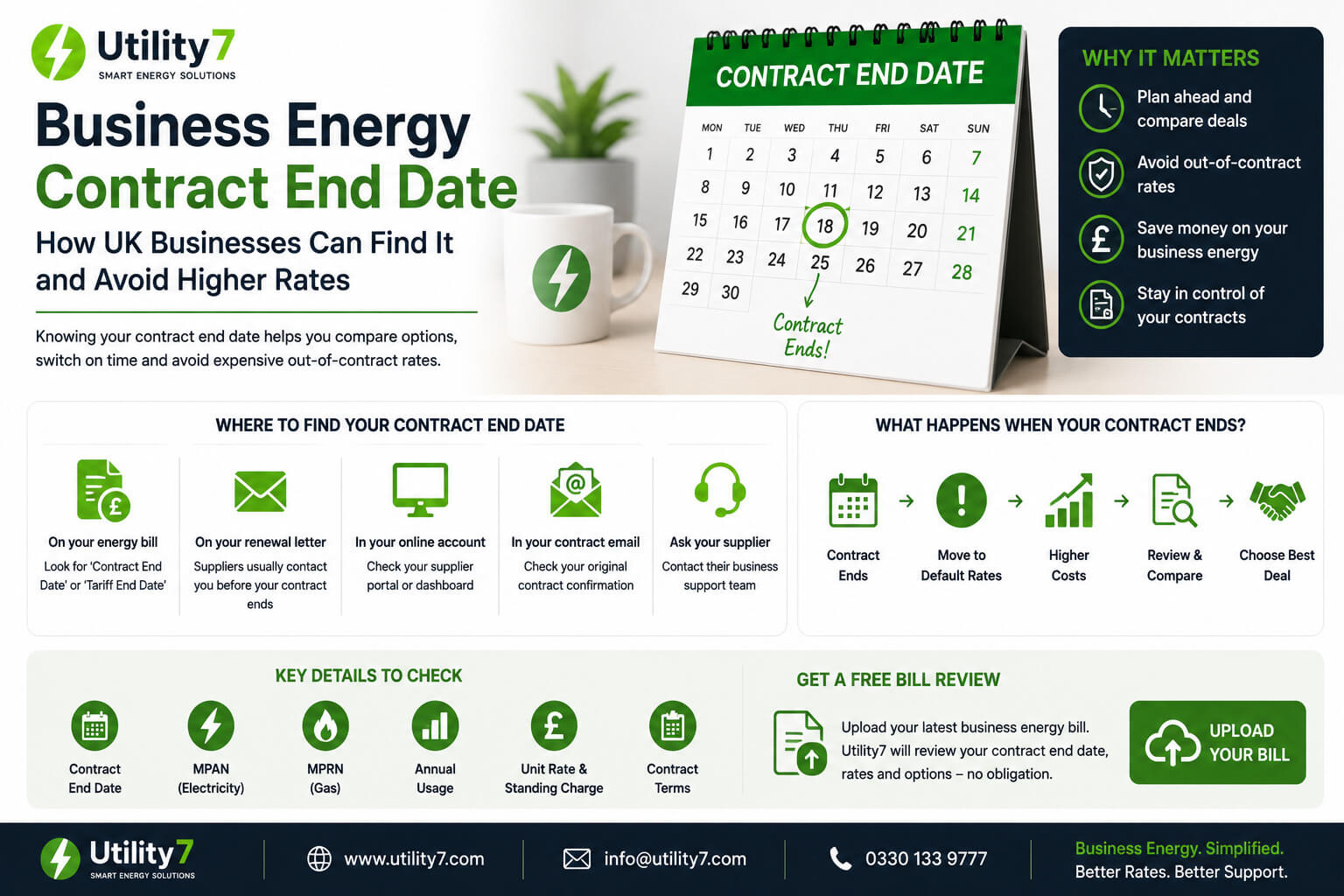
Your Business Energy Contract End Date is the date your current gas or electricity contract finishes. You can usually find it on your business energy bill, renewal letter, supplier portal, contract confirmation email or by contacting your supplier directly. Knowing this date helps your business compare renewal options early and avoid expensive out-of-contract or deemed rates.
- Check your bill: look for contract end date, tariff end date or renewal date.
- Check your renewal letter: suppliers may send renewal information before your fixed term ends.
- Check both fuels: gas and electricity may have different contract end dates.
- Act early: waiting too long can reduce your options and increase default-rate risk.
- Best action: upload your latest bill to Utility7 for a renewal review.
Contents
- Business Energy Contract End Date: Overview
- What Is a Business Energy Contract End Date?
- Where to Find Your Contract End Date
- Why Contract End Dates Matter
- Contract End Date vs Renewal Window
- What Happens If Your Contract Ends?
- Can You Switch Before Your Contract End Date?
- Gas and Electricity May Have Different End Dates
- What Details to Send to Utility7 for a Bill Review
- How to Avoid Higher Rates at Renewal
- Common Mistakes to Avoid
- How Utility7 Can Help Before Renewal
- Frequently Asked Questions
- Final Thoughts
Business Energy Contract End Date: Overview
Every UK business using gas or electricity should know its contract end date. This date tells you when your current energy agreement finishes and when your business may need to renew, switch or compare supplier options.
The problem is that many businesses do not check this date until it is too late. A business may sign a contract, file the paperwork away and forget about it until a renewal letter arrives or a higher bill appears. For busy SMEs, restaurants, takeaways, cafes, offices, salons, warehouses, care homes and retail shops, this is a common issue.
Your Business Energy Contract End Date matters because it affects when you can compare deals, whether you can switch supplier, whether notice is required and whether your business could move onto out-of-contract rates if no new contract is agreed.
This guide explains what a business energy contract end date is, where to find it, why it matters, what happens when your contract ends and how Utility7 can help review your bill before renewal.
Important note
Business energy contracts are commercial agreements. Always check your own supplier terms, renewal letter, notice rules and contract documents before signing or switching.
What Is a Business Energy Contract End Date?
A business energy contract end date is the date your current gas or electricity agreement comes to an end. It is sometimes called a tariff end date, supply contract end date, fixed term end date or renewal date.
If your business has a fixed-term energy contract, your rates and terms usually apply for a set period. This may be 12 months, 24 months, 36 months or another agreed term. When that period ends, your business must decide whether to renew, switch supplier or move onto another arrangement.
A business may have separate contract end dates for electricity and gas. For example, your electricity contract may end in September, while your gas contract may end in January. This is why it is important to check each bill separately.
The end date is not just an admin detail. It is one of the most important dates in business energy management because missing it can lead to poor renewal decisions and higher costs.
Where to Find Your Contract End Date
You can usually find your business energy contract end date in one of several places. The exact wording and layout depends on your supplier.
1. On your latest energy bill
Many suppliers show tariff or contract details on the bill. Look for wording such as:
- Contract end date
- Tariff end date
- Fixed term end date
- Supply contract end date
- Renewal date
- Agreement end date
If you are checking electricity, also look for the MPAN number. If you are checking gas, look for the MPRN number. These supply references help identify the correct meter and contract.
2. On your renewal letter or renewal email
Suppliers may send renewal information before a fixed-term business energy contract ends. This letter or email may include your current prices, new prices, usage information and options for renewal.
Read this carefully because it may include important dates and instructions. Do not assume the renewal offer is the best option without comparing the full annual cost.
3. In your supplier online account
Some suppliers show contract information in the customer portal. Check the tariff section, account details, contract documents or renewal section.
4. In your contract confirmation email
When your business originally signed the energy contract, the supplier or broker may have sent a confirmation email. This may include the contract start date, contract end date, unit rate, standing charge and supply details.
5. By contacting your supplier
If you cannot find the end date, contact your supplier and ask them to confirm it in writing. Ask for the contract end date for each meter and each fuel separately.
Why Contract End Dates Matter
Your contract end date matters because it helps you plan your renewal properly. If you know the date early, you can compare options, check contract terms, understand current rates and avoid being rushed.
A contract end date helps your business:
- Know when the current contract finishes
- Compare supplier options before the deadline
- Check whether notice is required
- Avoid out-of-contract rates
- Review current unit rates and standing charges
- Check annual consumption before renewal
- Review broker fee or commission details
- Plan cashflow and future utility costs
For high-usage businesses, even a small difference in unit rate can make a large difference over a year. For low-usage businesses, standing charges may have a bigger impact. Either way, knowing your end date gives you time to compare properly.
Contract End Date vs Renewal Window
Your contract end date and renewal window are connected, but they are not the same thing.
| Term | Meaning |
|---|---|
| Contract end date | The date your current business energy contract finishes. |
| Renewal window | The period before the end date when your business should compare and agree renewal options. |
| Notice period | The notice that may be required under some contract terms before switching or ending certain arrangements. |
A business should not wait until the end date itself. By then, there may not be enough time to compare properly, check broker fees, review contract terms or process a switch.
Utility7’s Business Energy Renewal Checklist explains the key details to review before signing a new contract.
What Happens If Your Contract Ends?
If your business energy contract ends and no new contract is agreed, your supplier may place the account on a default arrangement. This can lead to higher costs.
Common outcomes after a contract ends may include:
- The business moves onto out-of-contract rates
- The supplier offers a renewal rate
- The business signs a new fixed-term contract
- The business switches supplier if allowed
- The business pays variable or default rates until a new deal is agreed
Out-of-contract rates are often more expensive than negotiated business energy rates. If your business has already moved onto out-of-contract prices, it is sensible to review your latest bill quickly and compare available options.
If a business is using energy without a formal contract, such as after moving into a new premises, deemed rates may apply. Read Utility7’s guide on Deemed Rates vs Out-of-Contract Rates for a full explanation.
Can You Switch Before Your Contract End Date?
In many cases, business energy suppliers may not allow a switch before the contract end date. Business energy contracts are commercial agreements, so your ability to switch early depends on the supplier and contract terms.
Before trying to switch early, check:
- Contract end date
- Notice period
- Exit fee or termination charge
- Whether the supplier allows early termination
- Whether the business has moved premises
- Whether there has been a change of ownership
- Whether the current contract is fixed, variable, deemed or out of contract
If the contract has already ended, your business may have more flexibility. If you are on a deemed or out-of-contract rate, the switching position may be different from a fixed-term contract. Always confirm with your supplier before taking action.
For more background, read Utility7’s guide on Fixed vs Flexible Business Energy Contracts.
Gas and Electricity May Have Different End Dates
Many businesses use both gas and electricity, but the contracts may not end on the same date. This can happen if they were signed at different times, switched with different suppliers or renewed separately.
You should check:
- Electricity supplier
- Electricity contract end date
- MPAN number
- Electricity unit rate and standing charge
- Gas supplier
- Gas contract end date
- MPRN number
- Gas unit rate and standing charge
If the dates are different, your business may need two renewal reminders. This is especially important for multi-site businesses with several meters and multiple contract dates.
For supply references, read Utility7’s MPAN Number guide and MPRN Number guide.
What Details to Send to Utility7 for a Bill Review
The best way to check your business energy contract end date is to review your latest bill and contract information. If you want Utility7 to review your business energy position, prepare the following details.
| Detail | Why It Helps |
|---|---|
| Latest electricity bill | Shows MPAN, supplier, tariff, usage, unit rate and standing charge. |
| Latest gas bill | Shows MPRN, supplier, tariff, usage, unit rate and standing charge. |
| Contract end date | Confirms when your current deal finishes. |
| Annual consumption | Helps compare estimated annual costs properly. |
| Renewal letter | Shows renewal offer, new rates, dates and supplier options. |
| Current contract confirmation | Helps confirm agreed rates, term length and contract dates. |
If you do not have your latest bill, try to collect the supplier name, supply address, meter serial number, MPAN for electricity or MPRN for gas.
If you need help finding your gas reference without a bill, read Utility7’s guide on how to find MPRN number without bill.
How to Avoid Higher Rates at Renewal
The best way to avoid higher rates is to prepare before your contract end date. Do not wait until the final day or after the contract has already ended.
Follow these steps:
- Find your contract end date: check your bill, renewal letter or supplier portal.
- Record the date: add it to a renewal tracker or calendar.
- Check current rates: note your unit rate and standing charge.
- Check annual usage: use kWh figures from actual bills where possible.
- Compare estimated annual costs: not just headline rates.
- Ask about fees: check exit fees, broker fees and commission.
- Review contract terms: understand notice period and renewal rules.
- Confirm in writing: keep written confirmation of any new contract.
A simple renewal tracker can include supplier name, fuel type, MPAN or MPRN, contract end date, renewal window, current unit rate, standing charge, annual usage and notes.
Common Mistakes to Avoid
Business energy contract end dates are easy to miss if they are not tracked properly. Avoid these common mistakes:
- Only checking the total amount due on the bill.
- Not looking for the contract end date.
- Assuming gas and electricity end on the same date.
- Ignoring renewal letters or emails.
- Waiting until the contract has already ended.
- Not checking notice period or exit fees.
- Comparing only the unit rate.
- Ignoring standing charges and estimated annual cost.
- Not checking MPAN or MPRN details.
- Not asking how broker fees or commissions are included.
- Signing a new contract without written confirmation of terms.
The easiest way to avoid these mistakes is to review your bill early and keep a clear record of all contract dates.
How Utility7 Can Help Before Renewal
Utility7 helps UK businesses review gas and electricity bills, identify key contract details and compare available business energy options. If you are unsure about your Business Energy Contract End Date, Utility7 can help check the bill and explain what information matters before renewal.
Utility7 can help with:
- Checking business energy contract end dates
- Reviewing electricity bills
- Reviewing gas bills
- Identifying MPAN and MPRN numbers
- Checking current unit rates and standing charges
- Reviewing annual consumption
- Comparing estimated annual costs
- Explaining renewal window and default-rate risk
- Supporting business electricity, gas, water and card machine reviews
Not sure when your energy contract ends?
Upload your latest business gas or electricity bill to Utility7. Our team can review your contract end date, unit rate, standing charge, annual usage and renewal options.
Upload your latest bill or contact Utility7 today
for a free, no-obligation review.
Frequently Asked Questions
What is a business energy contract end date?
A business energy contract end date is the date your current gas or electricity contract finishes. It tells your business when the current agreement ends and when renewal or switching options should be reviewed.
Where can I find my business energy contract end date?
You can usually find it on your latest bill, renewal letter, supplier portal, contract confirmation email or by contacting your supplier directly.
What happens when my business energy contract ends?
If no new contract is agreed, your business may move onto out-of-contract rates or another default pricing arrangement. These rates can be more expensive than negotiated contract rates.
Can I switch before my business energy contract end date?
It depends on your supplier and contract terms. Many business energy contracts restrict switching before the contract ends, and exit fees may apply in some cases. Always check your contract terms first.
Do gas and electricity contracts have the same end date?
Not always. Your gas and electricity contracts may have different suppliers, different start dates and different end dates. Check each bill separately.
What should I check before renewing a business energy contract?
Check the contract end date, renewal window, notice period, current unit rate, standing charge, annual consumption, estimated annual cost, exit fee and broker fee or commission.
Can Utility7 help find my contract end date?
Yes. Utility7 can review your latest business gas or electricity bill and help identify your contract end date, supply details, current rates and renewal options.
Final Thoughts
Your Business Energy Contract End Date is one of the most important details on your business gas or electricity account. If you know the date early, you can compare renewal options, review contract terms and avoid being moved onto expensive default rates.
Do not wait until the contract has already ended. Check your latest bill, renewal letter or supplier portal and record the date in a renewal tracker. If your business has both gas and electricity, check both contracts separately.
Before signing a new contract, compare the total annual cost, not only the unit rate. Review standing charges, annual consumption, notice period, exit fees, broker fees and out-of-contract risk.
As a Business energy broker UK, Utility7 helps businesses review business electricity, business gas, business water and card machine services.
Methodology and Source Notes
This article has been written using Utility7 service context and UK business energy guidance. It is designed to help businesses understand contract end dates, renewal windows, switching timing and default-rate risks. Businesses should always confirm their own supplier terms, notice requirements, contract dates and live pricing before signing or switching.
- Ofgem: Set up a business energy contract
- Ofgem: Get energy for your business
- Citizens Advice: Switching your small business energy supplier
- Utility7: Business Energy Renewal Checklist
- Utility7: Deemed Rates vs Out-of-Contract Rates
- Utility7: Fixed vs Flexible Business Energy Contracts
- Utility7: MPAN Number Guide
- Utility7: MPRN Number Guide
- Utility7 Business Electricity
- Utility7 Business Gas
- Contact Utility7