
Quick answer
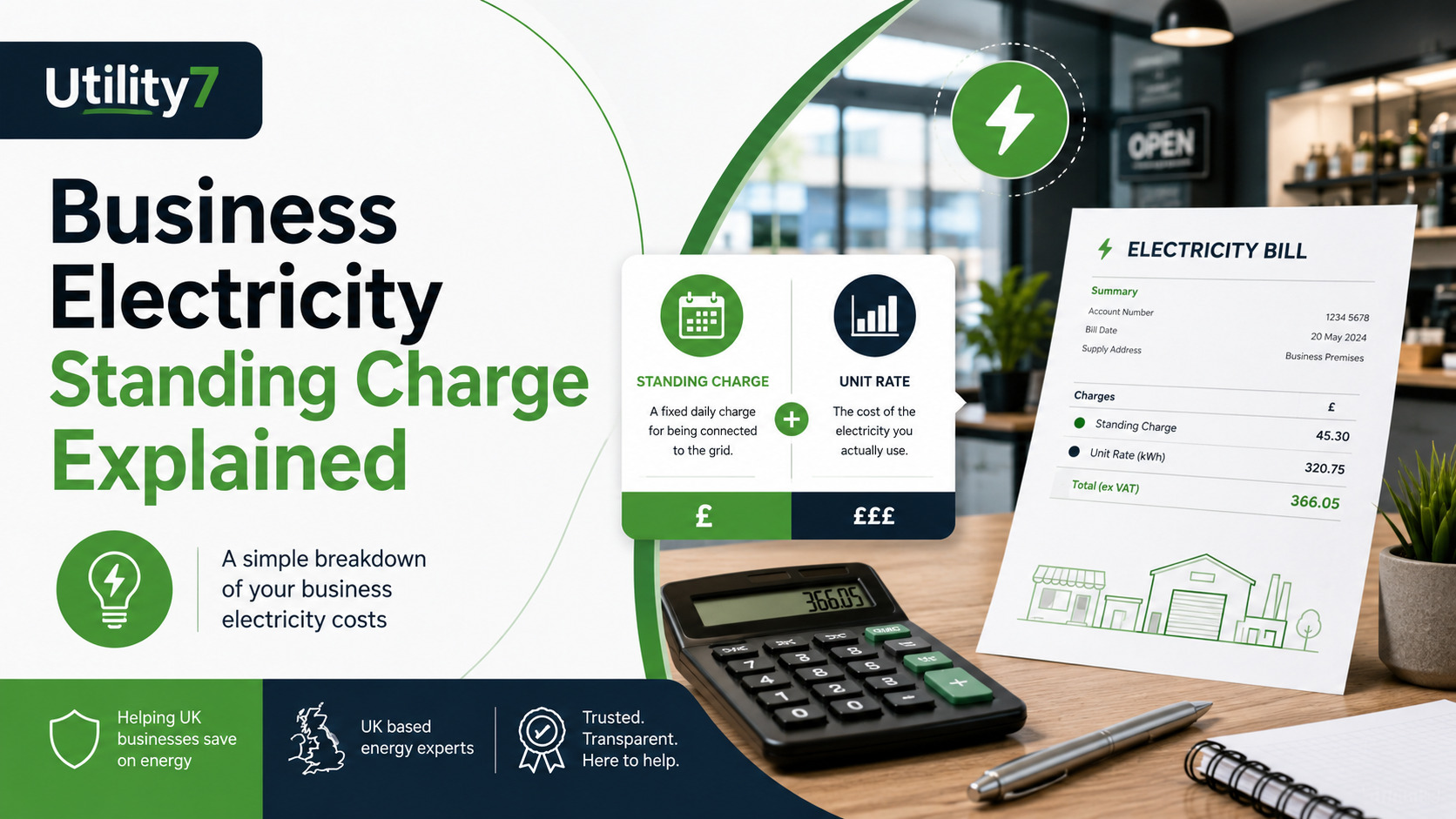
Business Electricity Standing Charge Explained simply means understanding the fixed daily cost your business may pay for having an electricity supply, even before any electricity is used. It is separate from the unit rate, which is the price you pay for each kWh of electricity consumed.
- Standing charge: a fixed daily cost linked to keeping your electricity supply available.
- Unit rate: the price per kWh for the electricity your business actually uses.
- Total bill: standing charge + usage charges + VAT + other applicable charges.
- Best action: compare the full annual cost, not only the unit rate.
Contents
- Business Electricity Standing Charge Explained: Overview
- What Is a Business Electricity Standing Charge?
- Standing Charge vs Unit Rate
- Why Do Businesses Pay Standing Charges?
- How Standing Charges Affect Your Bill
- Business Electricity Standing Charge Example
- High-Usage vs Low-Usage Businesses
- Can You Get Business Electricity with No Standing Charge?
- Does the Energy Price Cap Apply to Business Standing Charges?
- How to Compare Business Electricity Deals
- Common Mistakes to Avoid
- How Utility7 Can Help
- Frequently Asked Questions
- Final Thoughts
Business Electricity Standing Charge Explained: Overview
If you run a UK business, your electricity bill is usually made up of more than one cost. Many business owners focus only on the unit rate, but the standing charge can also affect the total annual cost.
A standing charge is normally shown as a daily amount. Your business may pay it for every day the electricity supply is available, even if the premises uses little or no electricity on some days.
This matters for businesses such as shops, offices, restaurants, takeaways, cafes, salons, warehouses, clinics, care providers and seasonal businesses. A business with low usage may find that the standing charge forms a larger part of the bill. A high-usage business may be more affected by the unit rate.
This guide provides Business Electricity Standing Charge Explained in simple terms. It explains what a standing charge is, how it differs from a unit rate, why it appears on bills, how to compare electricity deals properly and what mistakes to avoid before agreeing a new business electricity contract.
Important note
A lower standing charge does not always mean a cheaper electricity contract. Some tariffs may have a lower standing charge but a higher unit rate. Always compare the estimated annual cost using your real business usage.
What Is a Business Electricity Standing Charge?
A business electricity standing charge is a fixed daily cost that may appear on your electricity bill. It is separate from the amount you pay for the electricity your business uses.
For example, if your standing charge is shown as a daily pence amount, that cost is usually added for each day in the billing period. This means your business may still pay a standing charge even during quiet periods, weekends, holidays or days when usage is very low.
The standing charge can help cover fixed costs connected with supplying electricity to your premises. These may include network-related costs, metering, maintaining access to the supply and supplier administration.
The exact standing charge depends on the supplier, contract type, meter profile, region, business size, usage pattern and other commercial factors. It is not the same for every business.
Standing Charge vs Unit Rate
The easiest way to understand your business electricity bill is to separate fixed costs from usage costs.
| Bill Item | What It Means |
|---|---|
| Standing charge | A fixed daily charge for having electricity supply available to the premises. |
| Unit rate | The price per kWh for the electricity your business actually uses. |
| Usage charge | Your electricity consumption multiplied by the unit rate. |
| Total bill | Standing charge + usage charge + VAT + any other applicable charges. |
A business with high electricity usage may care more about the unit rate because the usage charge is the biggest part of the bill. A business with low usage may care more about the standing charge because it can make up a larger share of total cost.
This is why comparing only one part of the bill can be misleading. You need to compare the combined annual cost.
Why Do Businesses Pay Standing Charges?
Businesses may pay standing charges because there are fixed costs involved in keeping an electricity supply available. These costs can exist even if the business uses very little electricity.
Standing charges may relate to:
- Maintaining connection to the electricity network
- Metering and meter-related services
- Supplier administration
- System and infrastructure costs
- Costs that do not vary directly with daily electricity usage
The way these costs are recovered can vary by supplier and contract. Some contracts may show a higher standing charge with a lower unit rate. Others may show a lower standing charge with a higher unit rate.
For businesses, this means the “best” contract depends on usage pattern. A low standing charge is not automatically best. A low unit rate is not automatically best either.
How Standing Charges Affect Your Bill
The standing charge is usually calculated by multiplying the daily standing charge by the number of days in the billing period.
Example formula:
Daily standing charge × number of billing days = standing charge cost
If your business electricity bill covers 30 days, your standing charge is applied for 30 days. If the bill covers 365 days, the annual standing charge is the daily rate multiplied by 365.
Your total electricity cost is then calculated by adding usage charges, standing charges, VAT and any other applicable items.
Business Electricity Standing Charge Example
The example below is simplified and for illustration only. Actual rates vary by supplier and contract.
| Item | Example | Cost |
|---|---|---|
| Daily standing charge | 80p per day | £0.80 daily |
| Billing period | 30 days | 30 × £0.80 = £24.00 |
| Electricity usage | 1,000 kWh at 25p/kWh | £250.00 |
| Estimated subtotal | Before VAT and other charges | £274.00 |
In this example, the standing charge is not the largest part of the bill, but it still affects the total cost. For businesses with much lower usage, the standing charge could make up a higher percentage of the bill.
High-Usage vs Low-Usage Businesses
Standing charges affect businesses differently depending on usage.
Low-usage businesses
A small office, seasonal unit, storage space or low-consumption business may use relatively little electricity. In this case, the standing charge can become a significant part of the overall bill.
A low-usage business may prefer to compare tariffs with lower standing charges, but it must still check whether the unit rate is higher.
High-usage businesses
Restaurants, takeaways, cafes, bakeries, warehouses, care homes, manufacturers and businesses using electric heating, refrigeration or specialist equipment may use a lot of electricity.
For these businesses, the unit rate can have a much bigger impact than the standing charge. A slightly lower unit rate may save more than a lower daily standing charge, depending on annual usage.
Seasonal businesses
Seasonal businesses should look carefully at standing charges because they may continue to apply during quieter months. If usage drops but the standing charge remains, the bill may not fall as much as expected.
Can You Get Business Electricity with No Standing Charge?
Some businesses may ask whether they can get a business electricity contract with no standing charge. In some cases, suppliers may offer tariffs with no or low standing charge, but these tariffs may come with a higher unit rate.
This means a no-standing-charge tariff is not automatically cheaper. It may be suitable for very low usage sites, but it may be expensive for businesses that use a lot of electricity.
Before choosing a no-standing-charge or low-standing-charge option, compare:
- Daily standing charge
- Unit rate per kWh
- Annual electricity usage
- Estimated annual cost
- Contract length
- Payment method
- Supplier terms
- Any additional charges
The right choice depends on actual usage, not just the advertised structure.
Does the Energy Price Cap Apply to Business Standing Charges?
No. The domestic energy price cap does not protect customers with a business energy contract. Business electricity contracts are usually commercial agreements between the supplier and the business.
This means business standing charges and unit rates can vary significantly based on supplier, meter type, location, usage, credit profile, contract length and market conditions.
Because there is no standard business price cap protecting business contracts in the same way as domestic standard variable tariffs, businesses should compare carefully before signing or renewing.
How to Compare Business Electricity Deals
When comparing business electricity quotes, do not focus only on the standing charge or only on the unit rate. Compare the total annual cost based on your expected usage.
To compare properly, collect:
- Your latest business electricity bill
- MPAN number
- Current supplier
- Current unit rate
- Current standing charge
- Annual usage in kWh
- Contract end date
- Meter type
- Supply address
- Payment method
A good comparison should show the estimated annual cost, not only the headline rate. This makes it easier to compare contracts with different standing charges and unit rates.
You may also want to read Utility7’s guide on cheapest business electricity rates UK and fixed vs flexible business energy contracts before choosing a new contract.
Common Mistakes to Avoid
Many businesses make mistakes when comparing electricity standing charges because they look at only one part of the bill.
Avoid these common mistakes:
- Choosing a contract only because the standing charge is low.
- Ignoring the unit rate.
- Comparing daily standing charges without calculating annual cost.
- Not checking annual usage in kWh.
- Forgetting VAT and other applicable charges.
- Not checking the contract end date.
- Letting the contract expire and moving onto out-of-contract rates.
- Not checking whether the quote matches the correct MPAN.
- Assuming business prices are protected by the domestic price cap.
- Not comparing more than one supplier option.
The safest approach is to compare the full annual cost using your real usage and contract details.
How Utility7 Can Help
Utility7 helps UK businesses review electricity bills, understand key charges and compare available business electricity options. If you want Business Electricity Standing Charge Explained in relation to your own bill, Utility7 can help you identify the standing charge, unit rate, contract end date and estimated annual cost.
Utility7 can help with:
- Reviewing your business electricity bill
- Identifying your standing charge and unit rate
- Checking your MPAN number
- Reviewing your annual kWh usage
- Checking your contract end date
- Comparing available business electricity options
- Explaining fixed, flexible and default rate options
- Reviewing business gas, water and card machine services
Want to understand your electricity standing charge?
Send your latest business electricity bill to Utility7. Our team can help review your standing charge, unit rate, usage and contract options clearly.
Contact Utility7 today
for a free, no-obligation review.
Frequently Asked Questions
What is a business electricity standing charge?
A business electricity standing charge is a fixed daily cost that may apply to your electricity bill for having a supply available at your premises. It is separate from the unit rate charged for electricity usage.
Why do businesses pay a standing charge?
Businesses may pay a standing charge to cover fixed supply-related costs, such as network access, metering, supplier administration and other costs that do not depend only on how much electricity is used.
Is a lower standing charge always better?
No. A lower standing charge may come with a higher unit rate. The best option depends on your annual electricity usage and total estimated annual cost.
Can business electricity have no standing charge?
Some suppliers may offer no-standing-charge or low-standing-charge options, but these may have higher unit rates. They should be compared carefully using real usage figures.
Does the energy price cap apply to business electricity standing charges?
No. The domestic energy price cap does not protect customers with a business energy contract. Business electricity prices are based on commercial contract terms.
Where can I find the standing charge on my bill?
The standing charge is usually shown in the charges, tariff details or bill breakdown section. It may be listed as a daily pence amount.
Can Utility7 help compare business electricity standing charges?
Yes. Utility7 can review your latest business electricity bill and help compare the total cost of available options, including standing charges and unit rates.
Final Thoughts
Business Electricity Standing Charge Explained is important because the standing charge can affect your total electricity cost, especially if your business has low or seasonal usage.
The standing charge is the fixed daily cost, while the unit rate is the cost for each kWh of electricity used. To choose the right business electricity contract, you need to compare both together.
A tariff with a low standing charge is not automatically cheaper. A tariff with a low unit rate is not automatically cheaper either. The right comparison depends on your actual annual usage, contract terms, meter details and business needs.
As a Business energy broker UK, Utility7 helps businesses review gas and electricity costs and compare available options clearly. Utility7 also supports business electricity, business gas, business water and card machine services.
Methodology and Source Notes
This article has been written using Utility7 service context and UK energy guidance. It is designed to help businesses understand electricity standing charges, unit rates and business electricity comparison basics. Businesses should check their own supplier terms, latest bill and live contract options before agreeing to any electricity contract.