
Quick answer
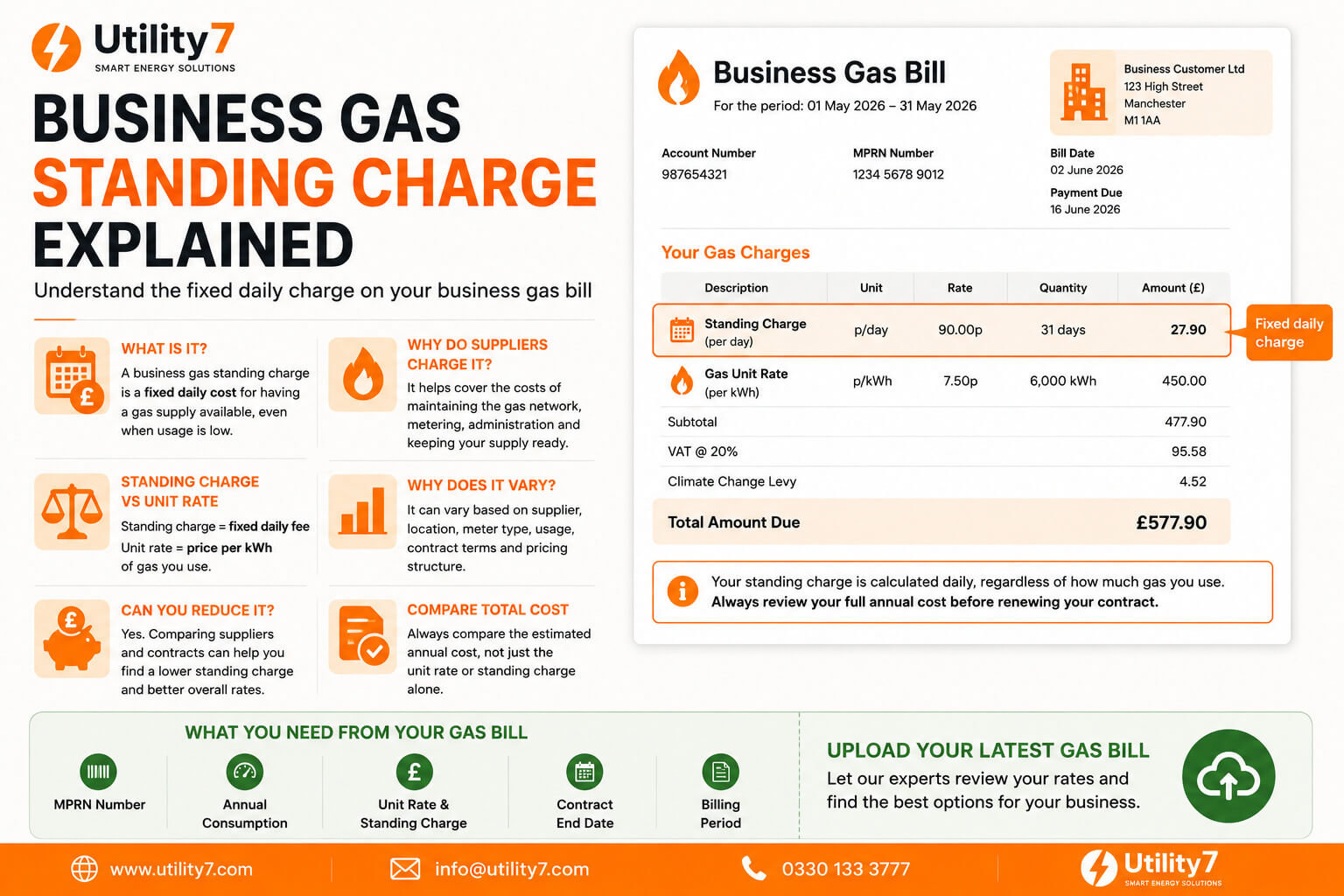
Business Gas Standing Charge Explained means understanding the fixed daily charge your business may pay for having a gas supply available, even when gas usage is low. It is separate from the gas unit rate, which is the price paid for each kWh of gas used.
- Standing charge: fixed daily gas supply cost.
- Unit rate: price per kWh of gas your business uses.
- Total gas cost: unit rate cost + standing charge + VAT + CCL where applicable.
- Best action: compare the total annual gas cost, not only the unit rate.
Contents
- Business Gas Standing Charge Explained: Overview
- What Is a Business Gas Standing Charge?
- Why Do Suppliers Charge a Gas Standing Charge?
- Business Gas Standing Charge vs Unit Rate
- Why Gas Standing Charges Vary
- Business Gas Standing Charge Example
- Can a Business Reduce Its Gas Standing Charge?
- How to Compare Total Annual Gas Cost
- What Details You Need from Your Gas Bill
- Why Standing Charges Matter for Low-Usage Businesses
- Renewal, Deemed Rates and Out-of-Contract Risk
- Common Mistakes to Avoid
- How Utility7 Can Review Your Business Gas Bill
- Frequently Asked Questions
- Final Thoughts
Business Gas Standing Charge Explained: Overview
Business gas bills can be confusing because the total amount is not based only on the gas your business uses. Many UK businesses also pay a daily standing charge. This charge may apply every day during the billing period, even if the business uses little or no gas on certain days.
This matters for restaurants, takeaways, cafes, hotels, care homes, bakeries, pubs, laundries, manufacturing sites, warehouses, offices and seasonal businesses. If your premises has a gas supply, the standing charge can affect your bill even during quiet trading periods.
This guide provides Business Gas Standing Charge Explained in simple terms. It explains what a gas standing charge is, why suppliers charge it, how it differs from the unit rate, why it varies, how to compare total annual gas cost and what information you need from your gas bill before reviewing a new contract.
The key message is simple: do not compare business gas contracts only by the unit rate. A contract with a lower unit rate but a higher standing charge may not always be cheaper. The best comparison should use your annual gas consumption and calculate the full estimated annual cost.
Important note
Business gas prices are commercial contract prices. Your standing charge, unit rate and contract terms can vary by supplier, meter, usage, location, payment method and market conditions.
What Is a Business Gas Standing Charge?
A business gas standing charge is a fixed daily charge that may appear on your gas bill. It is usually charged for each day your business has access to a gas supply, regardless of how much gas is used during that day.
For example, if your business gas standing charge is shown as 90p per day and the billing period is 30 days, the standing charge part of the bill would be £27 before VAT and other applicable charges.
The standing charge is separate from the gas unit rate. The unit rate is the price your business pays for each kilowatt-hour of gas used. The standing charge is a fixed daily cost.
You may see it on your bill as:
- Standing charge
- Daily charge
- Fixed daily charge
- Gas standing charge
- Supply charge
The wording can vary by supplier, but the purpose is similar: it is a fixed daily cost linked to having the gas supply available.
Why Do Suppliers Charge a Gas Standing Charge?
Gas suppliers may charge a standing charge because there are fixed costs involved in supplying gas to a business premises. These costs can exist even when gas usage is low.
A gas standing charge may help cover:
- Maintaining access to the gas network
- Metering and meter-related costs
- Supplier administration
- Account management and billing
- Fixed costs linked to supplying energy
- Network and infrastructure-related costs
In simple terms, the supplier may have costs to keep your gas account and supply active even when your business is not using much gas. This is why a standing charge can still apply during low-usage days, weekends, holidays or seasonal closures.
Not every gas contract is structured in exactly the same way. Some may have a higher standing charge and lower unit rate, while others may have a lower standing charge and higher unit rate.
Business Gas Standing Charge vs Unit Rate
The difference between standing charge and unit rate is one of the most important parts of understanding a business gas bill.
| Bill Item | What It Means |
|---|---|
| Gas standing charge | A fixed daily charge that may apply for having a gas supply available to the business premises. |
| Gas unit rate | The price per kWh for the gas your business actually uses. |
| Gas usage charge | Your gas consumption in kWh multiplied by your gas unit rate. |
| Total gas cost | Gas usage charge + standing charge + VAT + CCL or other applicable charges. |
For high-usage businesses, the unit rate often has the biggest impact on the bill. For low-usage or seasonal businesses, the standing charge can become a larger share of the total cost.
This is why Business Gas Standing Charge Explained should always include the unit rate as well. You cannot judge a gas contract properly by looking at the standing charge alone.
Why Gas Standing Charges Vary
Business gas standing charges are not always the same from one supplier or contract to another. They can vary depending on commercial and supply-related factors.
Common reasons gas standing charges vary include:
- Supplier pricing structure
- Business location and gas network area
- Meter type
- Annual gas consumption
- Contract length
- Payment method
- Credit profile or account risk
- Whether the contract is fixed, variable or out of contract
- Whether costs are bundled into the unit rate or shown separately
A supplier may offer a contract with a lower daily standing charge but a higher unit rate. Another supplier may offer a higher standing charge but a lower unit rate. Which one is cheaper depends on how much gas your business uses over the year.
For example, a bakery or restaurant using high gas volume may benefit more from a lower unit rate. A small office with very low gas use may pay more attention to the daily standing charge.
Business Gas Standing Charge Example
The example below is simplified and for illustration only. Actual business gas prices vary by supplier, meter, usage and contract terms.
| Item | Example | Cost |
|---|---|---|
| Daily standing charge | 90p per day | £0.90 daily |
| Billing period | 30 days | 30 × £0.90 = £27.00 |
| Gas usage | 5,000 kWh at 8p/kWh | £400.00 |
| Estimated subtotal | Before VAT and other charges | £427.00 |
In this example, the usage charge is much larger than the standing charge. But if the business used very little gas, the standing charge would represent a bigger part of the total bill.
Can a Business Reduce Its Gas Standing Charge?
A business may be able to reduce its gas standing charge by comparing supplier options before renewal or switching to a contract structure that better suits its usage pattern. However, a lower standing charge does not automatically mean a lower total cost.
To reduce or manage gas costs, your business can:
- Compare multiple business gas suppliers
- Check both unit rate and standing charge
- Compare estimated annual cost
- Review annual gas consumption
- Check whether the meter is still needed
- Review contract end date before renewal
- Avoid deemed or out-of-contract rates
- Ask how broker fees or commission are included
- Review gas usage and efficiency opportunities
If your business has a gas supply that is no longer used, speak to the supplier or relevant parties before making decisions. There may be procedures, costs or safety requirements involved in meter removal or disconnection.
The most practical first step is to review your latest bill and compare the full annual gas cost.
How to Compare Total Annual Gas Cost
The best way to compare business gas contracts is to calculate the estimated annual cost. This helps you compare different combinations of unit rates and standing charges.
A simple annual gas cost calculation is:
Annual gas usage × unit rate + annual standing charge = estimated annual gas cost
To calculate annual standing charge:
Daily standing charge × 365 = annual standing charge
When comparing offers, check:
- Annual gas consumption in kWh
- Gas unit rate
- Daily standing charge
- Estimated annual cost
- Contract length
- Payment method
- VAT and Climate Change Levy treatment
- Broker fee or commission
- Renewal terms and contract end date
Do not compare only the standing charge or only the unit rate. A proper comparison should show the total expected annual cost for your business.
What Details You Need from Your Gas Bill
Your latest gas bill is usually the best starting point for reviewing your current gas standing charge and comparing new options.
From your business gas bill, collect:
- Business name
- Supply address
- Current supplier
- MPRN number
- Meter serial number
- Billing period
- Gas consumption in kWh
- Current gas unit rate
- Current gas standing charge
- Annual consumption estimate
- Contract end date
- VAT and CCL details
- Total amount due
The MPRN is especially important for gas comparison because it identifies the gas supply point. If you cannot find it, read Utility7’s guide on MPRN Number.
If you do not have a bill, read Utility7’s guide on how to find MPRN number without bill.
Why Standing Charges Matter for Low-Usage Businesses
The business gas standing charge can be especially important for low-usage businesses. If a business uses very little gas, the daily standing charge may form a large share of the total bill.
This can affect:
- Small offices with gas only used for heating
- Seasonal businesses
- Businesses with low winter usage
- Vacant or partly used commercial premises
- Businesses that have changed operations and now use less gas
- Premises where gas equipment is no longer used regularly
For a low-usage business, a tariff with a lower unit rate but high standing charge may not be the best option. For a high-usage business, a higher standing charge may be less important if the unit rate is much lower.
This is why usage data matters. Always compare gas contracts using your real annual kWh usage where possible.
Renewal, Deemed Rates and Out-of-Contract Risk
Business gas standing charges can become a bigger issue if your contract ends and your business moves onto default rates. These rates may include higher unit rates, higher standing charges or less favourable terms.
Two common situations are:
- Deemed rates: often apply when a business uses gas without agreeing a contract first, such as after moving into a new premises.
- Out-of-contract rates: often apply when a fixed business gas contract ends and no new contract has been agreed.
If your contract is ending soon, use Utility7’s Business Energy Renewal Checklist to review your contract end date, renewal window, notice period, current unit rate, standing charge, annual consumption, estimated annual cost and broker fee.
You can also read Utility7’s guide on Deemed Rates vs Out-of-Contract Rates for UK Businesses.
Common Mistakes to Avoid
When reviewing a business gas standing charge, avoid these common mistakes:
- Comparing only the gas unit rate
- Ignoring the daily standing charge
- Not converting the daily standing charge into annual cost
- Using estimated usage instead of actual annual consumption
- Not checking the MPRN number
- Not checking the contract end date
- Not asking about broker fee or commission
- Allowing the contract to move onto out-of-contract rates
- Assuming a lower standing charge always means a cheaper contract
- Not reviewing gas and electricity contracts together
The safest approach is to review the full bill, compare estimated annual cost and understand the contract terms before signing.
How Utility7 Can Review Your Business Gas Bill
Utility7 helps UK businesses review gas bills, understand standing charges and compare available business gas options. If you want Business Gas Standing Charge Explained in relation to your own bill, Utility7 can help identify the key figures and explain what they mean.
Utility7 can help with:
- Reviewing your latest business gas bill
- Identifying your MPRN number
- Checking your gas unit rate
- Checking your gas standing charge
- Reviewing annual gas consumption
- Checking contract end date
- Comparing estimated annual gas cost
- Explaining deemed and out-of-contract risk
- Reviewing electricity, water and card machine services
Want to review your business gas standing charge?
Upload your latest business gas bill to Utility7. Our team can review your unit rate, standing charge, annual usage, MPRN and contract end date before you agree a new gas contract.
Upload your latest bill or contact Utility7 today
for a free, no-obligation review.
Frequently Asked Questions
What is a business gas standing charge?
A business gas standing charge is a fixed daily charge that may apply for having a gas supply available at your premises. It is separate from the unit rate charged for gas usage.
Why do I pay a gas standing charge if my business uses little gas?
You may still pay a gas standing charge because it is a fixed daily charge linked to having the gas supply available. It can apply even when usage is low.
Is the gas standing charge the same as the unit rate?
No. The standing charge is a fixed daily cost. The unit rate is the price per kWh for the gas your business uses.
Can a business gas standing charge be reduced?
It may be possible to find a lower standing charge by comparing suppliers, but the total annual cost matters more than the standing charge alone. A lower standing charge may come with a higher unit rate.
Where can I find the gas standing charge on my bill?
It is usually shown in the charges, tariff details or bill breakdown section. It may appear as a daily pence amount or daily fixed charge.
What details do I need to compare business gas contracts?
You usually need your latest bill, MPRN number, supply address, current supplier, annual consumption, unit rate, standing charge and contract end date.
Can Utility7 review my business gas bill?
Yes. Utility7 can review your latest business gas bill and help explain your unit rate, standing charge, annual usage, MPRN and renewal options.
Final Thoughts
Business Gas Standing Charge Explained is important for any UK business that wants to understand its gas bill properly. The standing charge is the fixed daily cost, while the unit rate is the price for the gas your business uses.
A lower standing charge is not always better. A lower unit rate is not always better either. The right comparison depends on your annual gas consumption, daily standing charge, unit rate, contract length, payment terms and total estimated annual cost.
Before renewing or switching, check your latest bill, MPRN number, unit rate, standing charge, annual usage and contract end date. This will help your business make a clearer decision before signing a new gas contract.
As a Business energy broker UK, Utility7 helps businesses review business gas, business electricity, business water and card machine services.
Methodology and Source Notes
This article has been written using Utility7 service context and UK business energy guidance. It is designed to help businesses understand gas standing charges, unit rates and total annual gas cost comparison. Businesses should check their own supplier terms, latest bill and live contract options before agreeing to any gas contract.
- Ofgem: Get energy for your business
- Ofgem: Set up a business energy contract
- Ofgem: Standing charges explained
- Citizens Advice: Switching your small business energy supplier
- Utility7 Business Gas
- Utility7: MPRN Number Guide
- Utility7: How to Find MPRN Number Without Bill
- Utility7: Business Energy Renewal Checklist
- Utility7: Deemed Rates vs Out-of-Contract Rates
- Contact Utility7