
Quick answer
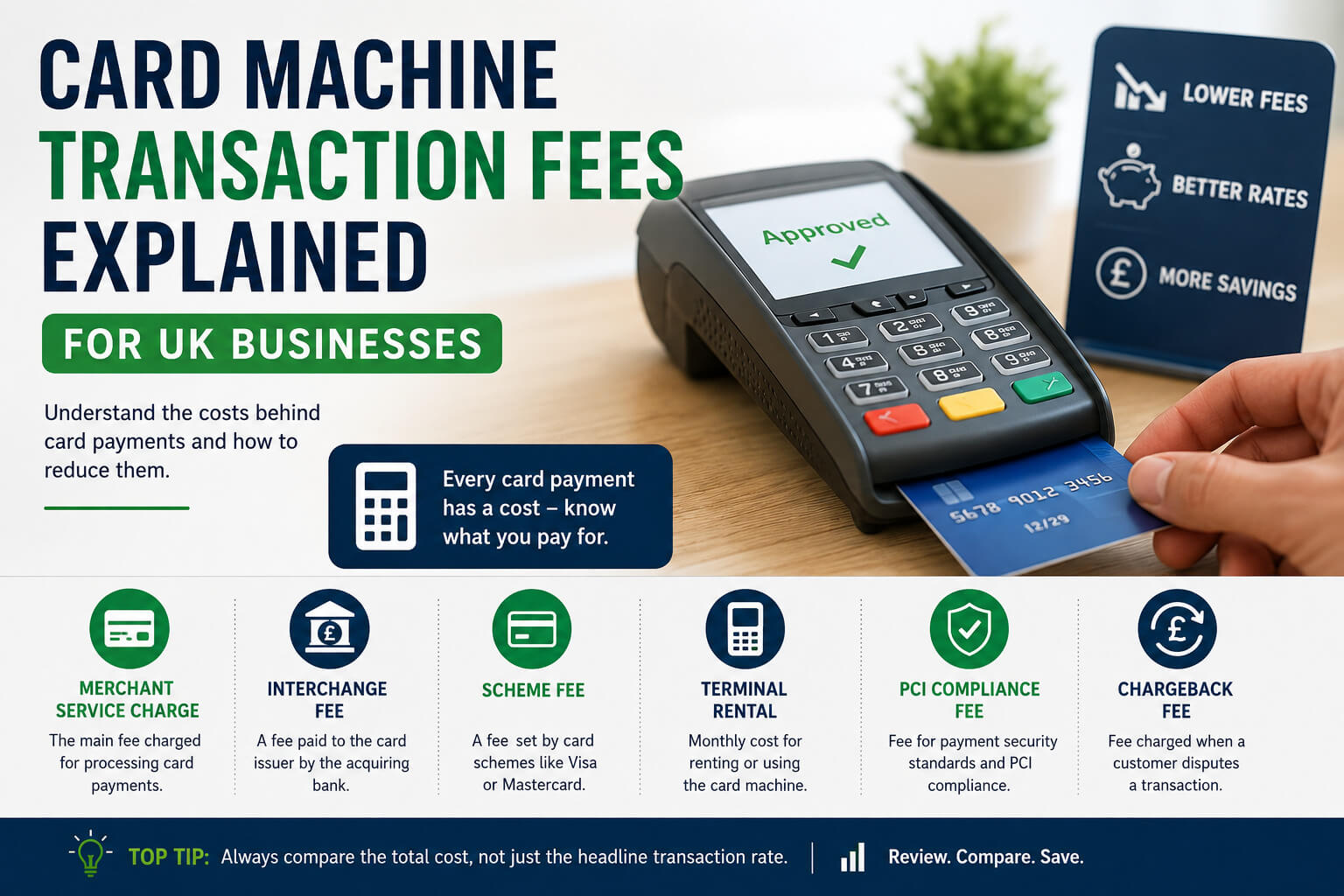
Card Machine Transaction Fees Explained means understanding the costs your business pays every time a customer uses a debit card, credit card, contactless payment, mobile wallet or online card payment. These fees may include merchant service charges, interchange fees, scheme fees, authorisation fees, terminal rental, PCI compliance costs, chargeback fees and settlement fees.
- Main cost: the transaction processing fee or merchant service charge.
- Other costs: card machine rental, gateway fees, PCI fees, chargeback fees and minimum monthly charges.
- Best action: compare the total monthly cost, not only the headline percentage rate.
- Important: UK businesses should check surcharging rules before adding extra card payment fees to customers.
Contents
- Card Machine Transaction Fees Explained: Overview
- What Are Card Machine Transaction Fees?
- Types of Card Machine Fees
- How Card Payment Fees Work
- Common Card Machine Pricing Models
- Hidden Costs to Watch For
- Fees by Business Type
- How to Compare Card Machine Providers
- How to Reduce Card Machine Fees
- Can Businesses Charge Customers Card Fees?
- Common Mistakes to Avoid
- How Utility7 Can Help
- Frequently Asked Questions
- Final Thoughts
Card Machine Transaction Fees Explained: Overview
Card payments are now essential for many UK businesses. Customers expect to pay by debit card, credit card, contactless, Apple Pay, Google Pay and sometimes online payment links. For restaurants, takeaways, cafes, salons, retail shops, convenience stores, taxis, trades, clinics and service businesses, a reliable card machine can make payments easier and faster.
However, card payments are not free for the business. Every card payment normally has a cost attached. Some costs are easy to see, such as a transaction percentage. Others are less obvious, such as terminal rental, monthly minimum charges, authorisation fees, PCI compliance charges or chargeback fees.
This guide provides Card Machine Transaction Fees Explained in simple terms for UK businesses. It explains what you may be paying, why different card types can cost different amounts, how pricing models work and what to check before choosing or switching a card machine provider.
The most important point is simple: do not compare card machine deals only by the headline transaction rate. A provider offering a low percentage rate may still be expensive if it includes high rental, long contracts, hidden charges or poor settlement terms.
Important note
Card machine fees vary by provider, card type, transaction volume, business sector, card-present or online payments, contract type and risk profile. Always check the full quote and written terms before signing.
What Are Card Machine Transaction Fees?
Card machine transaction fees are the charges a business pays when accepting card payments. These fees cover the payment processing chain that allows money to move from the customer’s card account to the business merchant account or bank account.
When a customer taps, inserts or enters card details, several parties may be involved, including the card issuer, acquiring bank, card scheme, payment processor, terminal provider and sometimes a payment gateway. The business normally sees these costs as part of its monthly card processing statement.
In simple terms, card machine costs can include:
- A percentage fee on each transaction
- A fixed fee per transaction
- Monthly card terminal rental
- Payment gateway fees for online payments
- PCI compliance charges
- Chargeback fees
- Refund fees
- Minimum monthly service charges
- Settlement or payout fees
- Early termination fees
For many small businesses, the percentage transaction fee gets most of the attention. But the full monthly cost can be much higher once all charges are added together.
Types of Card Machine Fees
A clear understanding of each fee type can help your business compare card machine deals more accurately.
| Fee Type | What It Means |
|---|---|
| Merchant Service Charge | The main fee charged for processing card payments. It may include interchange, scheme fees and processor/acquirer margin. |
| Interchange Fee | A fee paid from the merchant’s acquiring bank to the card issuer when a card payment is made. |
| Scheme Fee | A fee connected to card schemes such as Visa or Mastercard for using their network and processing rules. |
| Terminal Rental | A monthly fee for renting a countertop, portable or mobile card machine. |
| Authorisation Fee | A small fee that may apply when the payment is authorised by the card network or issuer. |
| PCI Compliance Fee | A fee related to Payment Card Industry security compliance support or administration. |
| Chargeback Fee | A fee that may apply if a customer disputes a transaction and the payment is reversed or investigated. |
How Card Payment Fees Work
When a customer pays by card, the payment is checked and authorised. The customer’s card issuer confirms whether the payment can proceed. The card scheme routes the transaction, and the acquiring bank or processor helps settle the payment to the business.
The business usually does not see every individual fee separately unless the provider uses a more detailed pricing model. Instead, the business may see a blended rate, such as a percentage of each transaction, plus monthly charges.
Fees can vary depending on:
- Debit card or credit card
- Consumer card or commercial card
- UK card or international card
- Card-present transaction or online transaction
- Contactless, chip and PIN or keyed transaction
- Monthly card turnover
- Average transaction value
- Business sector and risk level
- Provider pricing model
For example, a small cafe taking mostly low-value debit card payments may need a different card machine deal from a hotel taking larger payments, deposits and international cards.
Common Card Machine Pricing Models
Different providers use different pricing models. Understanding the model helps you compare properly.
1. Flat-rate pricing
Flat-rate pricing means the provider charges one simple rate for many transactions. This can be easy to understand, especially for small businesses or startups.
The downside is that a flat rate may be more expensive for businesses with higher card turnover, because the provider may price in extra risk and simplicity.
2. Interchange-plus pricing
Interchange-plus pricing separates the underlying interchange cost from the provider’s markup. This can be more transparent, but it may also be harder to read if the monthly statement is detailed.
It can be useful for larger businesses that want better visibility and may be able to negotiate lower margins.
3. Blended pricing
Blended pricing combines several costs into one headline rate. This is common because it is simple to explain. However, it can hide the difference between debit cards, credit cards, business cards and international cards.
4. Monthly rental plus transaction rate
Many traditional card machine contracts include monthly terminal rental plus a transaction processing rate. This may suit businesses that want a reliable terminal and support package, but the rental cost must be included in the total comparison.
Hidden Costs to Watch For
Some card machine deals look attractive at first because the headline transaction rate is low. But the total cost may increase once other charges are added.
Before signing, check for:
- Monthly terminal rental
- Minimum monthly service charge
- PCI compliance fee
- Non-compliance fee
- Payment gateway fee
- Authorisation fee
- Refund fee
- Chargeback fee
- Statement fee
- Batch fee
- Settlement fee
- Paper statement fee
- Early termination fee
- Contract rollover terms
This is why Card Machine Transaction Fees Explained should always include the full monthly cost, not only the transaction percentage.
Fees by Business Type
Different businesses need different payment setups. The cheapest provider for one business may not be the best for another.
Restaurants and takeaways
Restaurants and takeaways may need portable terminals, quick settlement, tips, refunds, integration with EPOS and reliable support during trading hours.
Retail shops
Retail shops often need countertop terminals, EPOS integration, receipt printing and clear transaction reporting.
Salons and clinics
Salons, clinics and appointment-based businesses may need deposits, booking system integration, payment links and recurring customer records.
Mobile businesses and trades
Mobile businesses may prefer mobile card readers, app-based payment terminals or payment links. Settlement speed and data connection reliability are important.
Hotels and higher-value businesses
Hotels and higher-value businesses may need pre-authorisation, deposits, refunds, international card handling and fraud checks.
How to Compare Card Machine Providers
To compare card machine providers properly, calculate the total cost based on your real transaction pattern.
Gather these details first:
- Average monthly card turnover
- Average transaction value
- Number of transactions per month
- Debit card and credit card split
- In-person and online payment split
- Current provider and current rates
- Monthly terminal rental
- Other monthly charges
- Contract end date
- Early termination terms
Then compare the total monthly cost using realistic figures. A provider with a lower transaction rate but higher rental may not always be cheaper. A provider with no monthly rental but a higher percentage may be better for low-volume businesses but more expensive for higher-volume businesses.
Practical tip
Ask every provider for a full cost breakdown using your actual monthly card turnover and average transaction value. This makes comparison much clearer.
How to Reduce Card Machine Fees
Many businesses stay with the same card machine provider for years without checking whether the rates are still competitive. Reviewing your card processing costs can help you understand whether you are paying more than necessary.
Ways to reduce card machine costs may include:
- Reviewing your current merchant statement
- Checking your contract end date
- Comparing multiple providers
- Negotiating based on actual card turnover
- Avoiding unnecessary terminal rental
- Removing unused terminals or payment tools
- Checking hidden monthly fees
- Improving fraud and chargeback controls
- Choosing the right terminal type for your business
- Reviewing settlement times and payout fees
The goal is not always to find the lowest headline rate. The goal is to find a card payment solution that is cost-effective, reliable and suitable for how your business accepts payments.
Can Businesses Charge Customers Card Fees?
UK businesses should be careful with card surcharges. Payment surcharging rules restrict charging customers extra for many payment methods, including many consumer card payments.
This means a business should not simply add an extra card fee to customers without checking the rules. There may be limited circumstances where different rules apply, such as some commercial card situations, but businesses should take proper advice and check current guidance before adding payment charges.
Instead of adding card surcharges, many businesses manage payment costs by reviewing providers, negotiating better rates, improving transaction reporting and choosing a more suitable card machine package.
Common Mistakes to Avoid
When comparing card machine transaction fees, avoid these common mistakes:
- Comparing only the headline percentage rate
- Ignoring monthly rental and minimum charges
- Not checking credit card and business card rates
- Not checking online payment or payment link fees
- Ignoring contract length and cancellation fees
- Not checking settlement times
- Keeping unused terminals
- Not reviewing merchant statements regularly
- Assuming all card transactions cost the same
- Adding customer surcharges without checking UK rules
A good card machine comparison should be based on your real payment volume, not just a generic advertised rate.
How Utility7 Can Help
Utility7 helps UK businesses review essential business services, including card machine solutions, business electricity, business gas and business water.
If you want Card Machine Transaction Fees Explained in relation to your own business, Utility7 can help you understand what to check before comparing card payment providers.
Utility7 can help with:
- Reviewing your current card machine costs
- Checking transaction rates and monthly fees
- Understanding terminal rental and contract terms
- Comparing card payment provider options
- Reviewing card machine needs by business type
- Supporting wider business utility reviews
- Comparing business electricity, gas and water services
Want to review your card machine costs?
Send your latest merchant statement or card machine bill to Utility7. Our team can help you understand the charges and compare available options for your business.
Contact Utility7 today
for a free, no-obligation review.
Frequently Asked Questions
What are card machine transaction fees?
Card machine transaction fees are the costs a business pays when accepting card payments. They may include a percentage transaction fee, fixed transaction fee, merchant service charge, terminal rental, PCI fees and other provider charges.
What is a merchant service charge?
A merchant service charge is the main fee businesses pay for card processing. It may include interchange fees, scheme fees and the acquirer or processor margin.
Are debit card fees cheaper than credit card fees?
Debit card transactions are often cheaper than credit card transactions, but the actual cost depends on the provider, card type, transaction method and pricing model.
Do card machine providers charge monthly fees?
Many providers charge monthly fees such as terminal rental, service fees, PCI compliance fees or minimum monthly charges. Some providers offer no-rental options but may charge a higher transaction rate.
Can businesses charge customers extra for card payments?
UK rules restrict surcharging for many card payments. Businesses should check current guidance before adding any card payment surcharge to customers.
How can I compare card machine fees?
Compare total monthly cost using your real transaction volume, average transaction value, card type mix, terminal rental, monthly fees, settlement terms and contract length.
Can Utility7 help compare card machine providers?
Yes. Utility7 can help businesses review card machine costs and compare available options alongside other business utilities.
Final Thoughts
Card Machine Transaction Fees Explained is important for any UK business that accepts card payments. The fees may look small per transaction, but they can add up quickly across hundreds or thousands of monthly payments.
The best way to understand your true cost is to review your merchant statement, identify all transaction and monthly fees, then compare providers using your actual sales volume. Do not focus only on the headline percentage rate.
For restaurants, takeaways, cafes, shops, salons, clinics, hotels, trades and service businesses, the right card machine solution should be reliable, affordable and suitable for how customers actually pay.
As a Business energy broker UK, Utility7 helps businesses review essential services including card machine services, business electricity, business gas and business water.
Methodology and Source Notes
This article has been written using Utility7 service context and official UK payments guidance. It is designed to help businesses understand card machine transaction fees, merchant service charges, interchange, scheme fees, terminal costs and card payment comparison basics. Businesses should check their own provider terms, merchant statements and current legal guidance before changing payment arrangements.
- Payment Systems Regulator: The Interchange Fee Regulation
- Payment Systems Regulator: IFR and merchants
- Payment Systems Regulator: Card-acquiring services market review
- Payment Systems Regulator: Card scheme and processing fees final report
- GOV.UK: Payment surcharges guidance
- Utility7 Card Machine Services
- Utility7 Business Electricity
- Utility7 Business Gas
- Utility7 Business Water
- Contact Utility7