
Quick answer
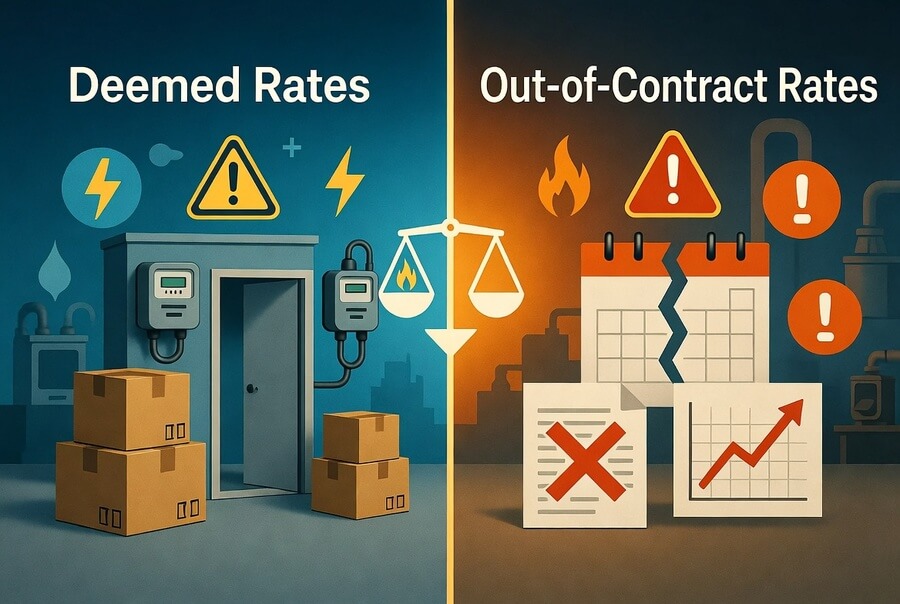
Deemed rates vs out-of-contract rates for UK businesses is mainly about why your business is paying default energy prices. Deemed rates usually apply when your business uses gas or electricity without agreeing a contract first, often after moving into a new premises. Out-of-contract rates usually apply when a fixed business energy contract ends and no new contract has been agreed.
- Deemed rates: common after moving into a new business premises without setting up a contract.
- Out-of-contract rates: common when your current contract expires and you do not agree a renewal or switch.
- Both can be expensive: they are usually not the best long-term option for a business.
- Best action: check your contract status, gather your MPAN or MPRN, compare business energy options and agree a suitable contract as soon as possible.
Contents
- Deemed Rates vs Out-of-Contract Rates: Overview
- Quick Difference Table
- What Are Deemed Rates?
- What Are Out-of-Contract Rates?
- Why These Rates Can Be Expensive
- How to Check Which Rate Your Business Is On
- Moving Business Premises: What to Do
- Contract Ended: What to Do
- How to Compare Business Energy Rates
- Common Mistakes to Avoid
- How Utility7 Can Help
- Frequently Asked Questions
- Final Thoughts
Deemed Rates vs Out-of-Contract Rates: Overview
Business energy contracts can be confusing, especially when a company receives a high electricity or gas bill and does not know why the rate has changed. Two common reasons are deemed rates and out-of-contract rates.
Many UK businesses do not realise they are on a default tariff until the bill arrives. This can happen after moving into a new commercial property, taking over a shop, restaurant, takeaway, office or warehouse, or letting an existing energy contract expire without arranging a new deal.
Understanding deemed rates vs out-of-contract rates for UK businesses helps you know what has happened, why the rate may be higher, and what action you should take next.
The main point is simple: both deemed and out-of-contract rates are usually not ideal as a long-term arrangement. If your business is on either one, it is sensible to review your latest bill, check your contract status and compare available business energy options.
Important note
Deemed rates and out-of-contract rates can vary by supplier, property, meter type, usage and market conditions. Always check your own bill and supplier terms before making a decision.
Quick Difference Table
The easiest way to understand the difference is to look at when each rate applies.
| Feature | Deemed Rates | Out-of-Contract Rates |
|---|---|---|
| When it applies | When energy is used without an agreed contract, often after moving into a premises. | When a fixed contract has ended and no new contract has been agreed. |
| Common situation | New tenant or new occupier starts using energy before arranging a supplier contract. | Existing business misses renewal date or does not switch before the contract ends. |
| Price type | Usually variable and set by the supplier under deemed contract terms. | Usually default supplier rates after contract expiry. |
| Best action | Contact supplier, confirm meter details and arrange a proper contract quickly. | Compare renewal or switching options as soon as possible. |
What Are Deemed Rates?
Deemed rates apply when a business uses energy without having agreed a formal contract with the supplier. In simple terms, the supplier is still providing energy to the premises, but you have not yet arranged a contract with them.
This often happens when a business moves into a new premises. For example, if you take over a restaurant, takeaway, shop, salon, office or warehouse and start using gas or electricity before agreeing a contract, the existing supplier may place you on deemed contract rates.
A deemed contract can also happen when there is a supply at a premises but no agreed contract has been set up by the new occupier. You are still responsible for the energy you use, even if you have not yet arranged a formal deal.
Deemed rates are usually not designed to be a long-term business energy solution. They are a default arrangement until the customer agrees a proper contract or switches supplier where possible.
Common reasons your business may be on deemed rates
- You moved into a new business premises without arranging an energy contract.
- You took over a site from a previous tenant.
- You do not know who supplies the property.
- The landlord or previous occupier did not provide energy details.
- You started using energy before contacting the supplier.
- The supplier has not yet created a formal contract in your business name.
What Are Out-of-Contract Rates?
Out-of-contract rates usually apply when your agreed business energy contract ends and no new contract has been arranged. This is different from a deemed contract because your business had a previous contract, but that contract has expired.
This can happen when a business misses the renewal window, forgets the contract end date, does not compare options early enough, or assumes the supplier will automatically keep the old rate.
Out-of-contract rates are often higher than negotiated fixed business energy rates. They can also be variable, meaning your unit rate and standing charge may change depending on supplier terms and market conditions.
Common reasons your business may be on out-of-contract rates
- Your fixed business electricity or gas contract ended.
- You did not agree a renewal before the end date.
- You missed supplier renewal notices.
- Your broker or internal team did not act before the deadline.
- You assumed the supplier would keep the same rate.
- You delayed comparing available business energy options.
Why These Rates Can Be Expensive
Deemed rates and out-of-contract rates are often more expensive because they are not usually negotiated contract rates. A fixed contract is normally agreed in advance with a specific unit rate, standing charge and contract length. A default rate may not offer the same level of price certainty.
For businesses with high usage, the difference can be significant. Restaurants, takeaways, cafes, bakeries, hotels, care homes, warehouses and manufacturing sites may use large amounts of energy, so a higher unit rate can quickly increase monthly costs.
Even for lower-usage businesses, a higher standing charge can make bills more expensive. That is why it is important to compare the full annual cost, not just the unit rate.
When reviewing deemed rates vs out-of-contract rates for UK businesses, the key takeaway is that both should trigger action. Your business should check the bill, confirm the contract status and look for a suitable contract as soon as possible.
How to Check Which Rate Your Business Is On
You can usually check your rate type by reviewing your latest business energy bill or supplier account. Look for wording that suggests you are not on an agreed fixed contract.
Check for:
- Deemed contract
- Deemed rates
- Out-of-contract rates
- Default rates
- Variable rates
- Contract end date
- Renewal notice
- Tariff type
- Unit rate and standing charge
If the bill is unclear, contact the supplier and ask:
- Am I currently on a deemed contract?
- Am I on out-of-contract rates?
- What is my current unit rate?
- What is my standing charge?
- When did my previous contract end?
- Can I switch or agree a new contract now?
- Are there any notice requirements or restrictions?
Moving Business Premises: What to Do
If you are moving into a new business premises, the best way to avoid deemed rates is to deal with the energy supply as early as possible.
Before or soon after moving in, you should:
- Take opening meter readings on the move-in date.
- Take clear photos of the gas and electricity meters.
- Find the MPAN for electricity and MPRN for gas.
- Ask the landlord or previous tenant who supplies the premises.
- Contact the supplier and confirm you are the new occupier.
- Compare available business energy options.
- Agree a suitable contract as soon as possible.
This is especially important for high-energy businesses such as restaurants, takeaways, cafes and food businesses, where bills can grow quickly if the wrong rate applies.
Contract Ended: What to Do
If your existing energy contract has ended and you are now on out-of-contract rates, the priority is to compare available options quickly.
Start by collecting:
- Your latest electricity or gas bill
- Current supplier name
- Contract end date
- MPAN for electricity
- MPRN for gas
- Annual usage in kWh
- Current unit rate
- Standing charge
- Supply address
Once you have this information, you can compare available business electricity or gas contracts and decide whether to renew, switch supplier or explore another contract type.
Practical tip
Do not wait until the final week of your contract. Start checking renewal options early so your business has enough time to compare prices and avoid default rates.
How to Compare Business Energy Rates
When comparing business energy rates, do not only look at the cheapest unit rate. A good comparison should consider the full cost and contract terms.
Review:
- Unit rate per kWh
- Standing charge
- Estimated annual cost
- Contract length
- Fixed or variable terms
- Payment method
- Supplier terms
- Renewal rules
- Notice requirements
- Broker fee or commission disclosure, where applicable
Businesses often search for cheapest business electricity rates UK or business gas prices, but the right contract depends on your actual usage, risk level and cashflow needs.
A Business energy broker UK can help review your current bill and explain available options clearly.
Common Mistakes to Avoid
Businesses often end up on deemed or out-of-contract rates because energy contract management is left too late.
Avoid these mistakes:
- Moving into a premises without contacting the supplier.
- Not taking opening meter readings.
- Not recording MPAN or MPRN details.
- Ignoring contract renewal emails or letters.
- Waiting until the final week to compare prices.
- Only comparing unit rates and ignoring standing charges.
- Assuming your old rate will continue after contract end.
- Not checking whether you are on deemed or out-of-contract rates.
- Letting multiple sites renew at different times without a tracker.
A simple energy renewal tracker can help. Record each site, supplier, contract end date, MPAN, MPRN, usage, unit rate and standing charge.
How Utility7 Can Help
Utility7 helps UK businesses review gas and electricity bills, check contract details and compare available energy options. If your business is on deemed rates or out-of-contract rates, Utility7 can help you understand what information to collect and what options may be available.
Utility7 can help with:
- Reviewing business electricity bills
- Reviewing business gas bills
- Checking unit rates and standing charges
- Identifying contract end dates
- Finding MPAN and MPRN details
- Comparing available supplier options
- Explaining fixed, flexible and default rate options
- Supporting business water and card machine comparisons
Are you on deemed or out-of-contract rates?
Send your latest business gas or electricity bill to Utility7. Our team can help review your current rates, check your contract status and explain available business energy options.
Contact Utility7 today
for a free, no-obligation review.
Frequently Asked Questions
What is the difference between deemed rates and out-of-contract rates?
Deemed rates usually apply when your business uses energy without first agreeing a contract, often after moving into a new premises. Out-of-contract rates usually apply when an existing fixed contract ends and no new contract has been arranged.
Are deemed rates expensive?
Deemed rates can be more expensive than negotiated business energy contracts. If your business is on deemed rates, it is sensible to contact the supplier and compare available options as soon as possible.
Are out-of-contract rates expensive?
Out-of-contract rates are often higher than agreed contract rates. They usually apply after your contract ends and can continue until you agree a new contract or switch supplier where possible.
How do I know if my business is on deemed rates?
Check your latest bill or contact your supplier. If you recently moved into a premises and have not agreed a contract, you may be on a deemed contract.
How do I know if my business is out of contract?
Check your contract end date on your bill, supplier portal or renewal notice. If the fixed term has ended and you have not agreed a new deal, your business may be on out-of-contract rates.
Can I switch from deemed rates?
In many cases, businesses can arrange a new contract or switch supplier, but the exact process depends on the supplier, account status and contract circumstances. Check with the supplier before taking action.
Can Utility7 help compare business energy rates?
Yes. Utility7 can review your latest gas or electricity bill, check current rates and help compare available business energy options.
Final Thoughts
Understanding deemed rates vs out-of-contract rates for UK businesses can help you act quickly when your energy bill looks higher than expected.
Deemed rates usually happen when energy is used before a formal contract is agreed, often after moving into a new premises. Out-of-contract rates usually happen when your fixed contract ends and no new contract has been arranged.
In both cases, the best response is to check your bill, confirm your contract status and compare available business energy options. Leaving your business on default rates for too long can make energy costs harder to manage.
As a Business energy broker UK, Utility7 helps businesses review gas and electricity costs and compare available options clearly. Utility7 also supports business electricity, business gas, business water and card machine services.
Methodology and Source Notes
This article has been written using Utility7 service context and official UK business energy guidance. It is designed to help businesses understand the difference between deemed rates and out-of-contract rates. Businesses should confirm their own supplier terms, contract status and live pricing before agreeing to any energy contract.
- Ofgem: Set up a business energy contract
- Ofgem: Get energy if you are moving home or business premises
- Ofgem: Guidance on deemed contracts
- Citizens Advice: Moving business premises energy supply
- Citizens Advice: Switching your small business energy supplier
- Utility7: Fixed vs Flexible Business Energy Contracts
- Utility7 Business Electricity
- Utility7 Business Gas
- Contact Utility7