
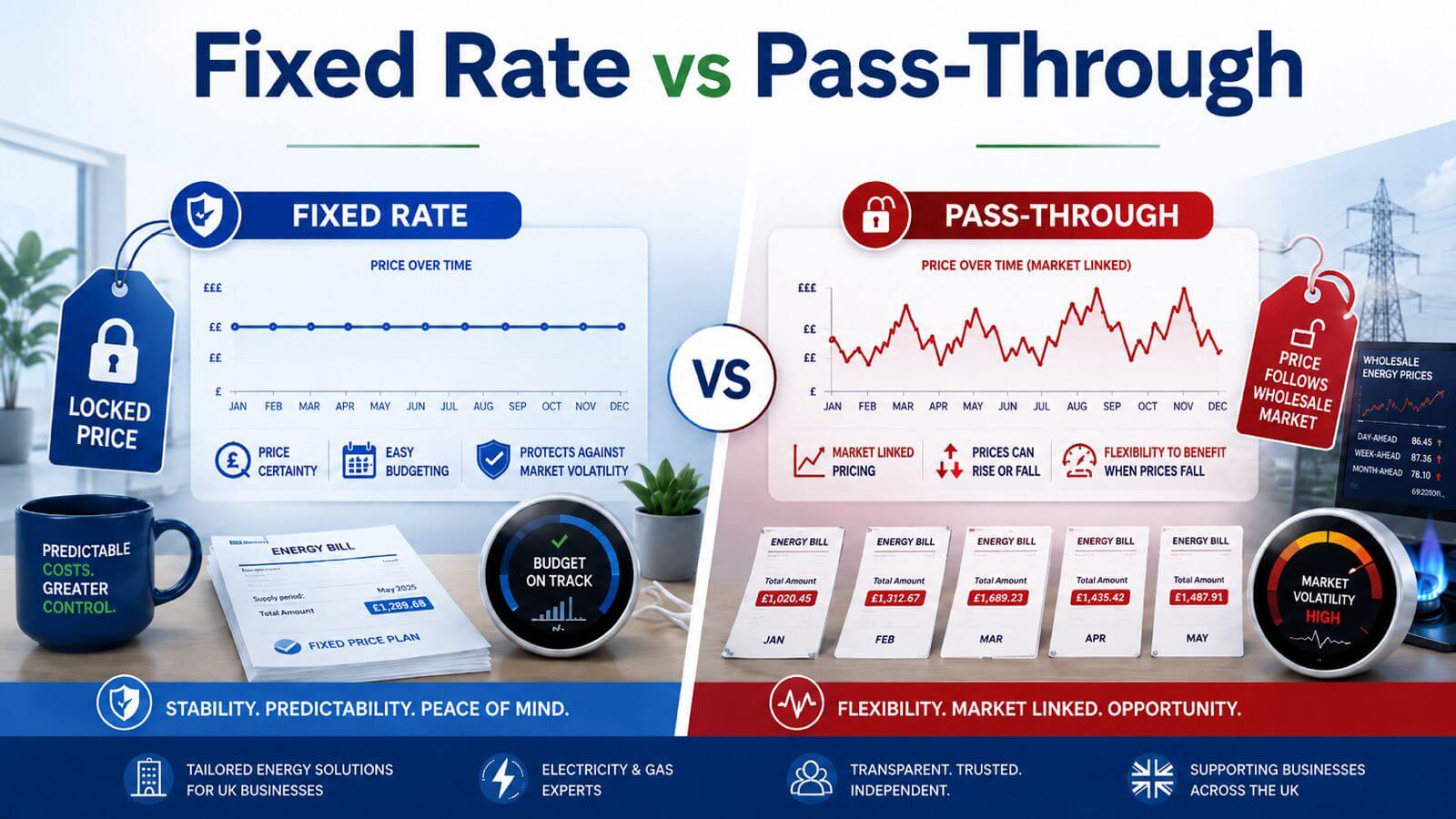
Fixed Rate vs. Pass-Through Energy Tariffs
In the volatile energy market of 2026, choosing the right tariff is more than just a paperwork exercise — it is one of the most consequential financial decisions your business can make. Get it right, and you could save thousands of pounds annually. Get it wrong, and you could be locked into an unfavourable deal while competitors enjoy lower overheads.
For most UK businesses, the choice boils down to two main contract structures: Fixed Rate and Pass-Through (Flexible). Each has distinct advantages and real risks. Understanding the nuances of both will help you protect your budget, plan with confidence, and take advantage of market opportunities.
This guide breaks down everything you need to know — in plain English.
What is a Fixed Rate Energy Tariff?
A fixed-rate tariff is exactly what it sounds like: the price you pay per unit of energy (kWh) is locked in for the full duration of your contract, regardless of what happens in the wholesale market. Contracts typically run for 1, 2, or 3 years.
How it works
When you agree to a fixed-rate deal, your supplier bundles together:
- The wholesale energy cost — the price of gas or electricity on the open market at the time of contracting
- Non-commodity charges — government levies, distribution costs (DUoS), transmission costs (TNUoS), balancing charges, and metering fees
- Supplier margin — the profit the supplier builds into the rate
All of these are rolled into a single unit rate and a standing daily charge. You pay the same rate whether energy prices rise sharply or collapse entirely.
The Advantages of a Fixed Rate Tariff
Complete price certainty. If the energy market surges — as it has done repeatedly in recent years — your bill stays exactly the same. This makes budgeting straightforward and removes a major source of financial risk from your operations.
Simple billing. One rate, one bill. There are no complex line items to decode, and you always know roughly what to expect each month.
Peace of mind. For business owners and finance teams who don’t want to monitor energy markets, fixed contracts are the “set and forget” solution. You agree a rate, sign a contract, and get on with running your business.
Protection against levy increases. In 2026, the UK Government continues to introduce and adjust green energy levies and network charges. With a fixed contract, any mid-term increases in these charges are absorbed by the supplier, not passed on to you.
The Disadvantages of a Fixed Rate Tariff
You miss out on price drops. If wholesale energy prices fall significantly after you’ve locked in your rate, you’ll continue paying the higher agreed price until your contract expires.
Early exit fees. Breaking a fixed contract early can be costly. If your business circumstances change — you move premises, downsize, or close — you may face significant termination charges.
The supplier prices in risk. Because the supplier is absorbing market volatility on your behalf, they typically build a risk premium into the rate. You are, in effect, paying a small “insurance fee” for the certainty you receive.
What is a Pass-Through (Flexible) Energy Tariff?
A pass-through tariff, sometimes called a flexible or transparent tariff, separates the components of your energy bill. The wholesale cost may be fixed or hedged, but the non-commodity charges are passed through to you at whatever rate applies at the time.
How it works
Instead of a single bundled rate, your bill is broken down into distinct components:
- Wholesale/commodity cost — often fixed or purchased via a hedging strategy
- TNUoS (Transmission Network Use of System) — the cost of transmitting electricity across the national grid
- DUoS (Distribution Use of System) — the cost of distributing energy through local networks
- BSUoS (Balancing Services Use of System) — charges for balancing supply and demand in real time
- Renewables levies (RO, FIT, CfD) — charges that fund the UK’s green energy commitments
- Supplier margin — typically lower than on a fixed deal
These charges fluctuate throughout the year, and you pay the actual rate — whatever it is at the time.
The 2026 Reality: Why Non-Commodity Charges Matter More Than Ever
Here is why this distinction is critically important right now: in 2026, non-commodity charges account for approximately 55–65% of the average UK business electricity bill. This is up from around 40% a decade ago.
That means even if the wholesale price of electricity is low, your bill can still be very high if network and levy charges are elevated. Pass-through contracts expose you directly to these fluctuations — which can be an advantage or a disadvantage depending on market conditions and your ability to manage consumption.
The Advantages of a Pass-Through Tariff
Full transparency. Every line item on your bill reflects the actual cost of each component. You know exactly what you’re paying for and why.
Potential for significant savings. If non-commodity charges fall — or if you actively manage your consumption to avoid peak-rate periods — your costs can be substantially lower than under a fixed deal.
Peak shaving opportunities. Pass-through contracts incentivise businesses to shift energy usage away from high-cost periods. DUoS “red band” charges (peak hours, typically weekday mornings and evenings) can be 5 to 10 times higher than off-peak rates. Businesses with operational flexibility — warehouses, manufacturers, cold storage facilities — can save thousands by timing energy-intensive activity during cheaper periods.
No supplier risk premium. Because you absorb the market risk yourself, suppliers don’t need to charge you for carrying it. The unit rate itself is often lower than a comparable fixed deal.
Flexible procurement strategies. Larger businesses on pass-through contracts can work with energy consultants to hedge portions of their wholesale energy at favourable times, building a bespoke procurement strategy.
The Disadvantages of a Pass-Through Tariff
Unpredictable bills. Your monthly costs will fluctuate, sometimes significantly. This makes cash flow management and budgeting more challenging.
Complexity. Understanding and auditing a pass-through bill requires energy knowledge or professional support. Billing errors are harder to spot without expertise.
Exposure to market spikes. If network charges or levies increase mid-contract, your bills rise immediately. There is no buffer.
Requires active management. To get the most out of a pass-through contract, you need to monitor your consumption, understand your half-hourly data, and respond to market signals. Without this, you may not save anything at all.
Fixed Rate vs. Pass-Through Energy Tariffs: Side-by-Side Comparison
| Feature | Fixed Rate Tariff | Pass-Through Tariff |
| Price Stability | High — rate is fully locked in | Low — bills change each month |
| Budgeting | Simple and predictable | Complex and variable |
| Transparency | Low — bundled single rate | High — every charge itemised |
| Market Risk | Carried by the supplier | Carried by the business |
| Savings Potential | Capped at agreed rate | Higher if charges fall or usage shifts |
| Complexity | Low — easy to manage | High — requires active monitoring |
| Typical Contract Length | 1–3 years | 1–3 years (or rolling) |
| Best For | SMEs, tight budgets, low risk appetite | Large businesses, energy-intensive industries, experienced procurement teams |
| Early Exit | Fees usually apply | More flexible in some cases |
| Non-Commodity Exposure | None — bundled by supplier | Full — passed through directly |
Real-World Examples
Example 1: The Restaurant Owner (Fixed Rate Wins)
Sarah runs a mid-sized restaurant in Birmingham with an annual electricity spend of around £18,000. Her business operates on tight margins, and she doesn’t have time to monitor energy markets. She signed a 2-year fixed deal through Utility7 in early 2025, locking in her rate before a significant rise in network charges. Her competitors on variable deals saw their bills increase by an average of 12% mid-year. Sarah’s bill stayed exactly the same.
Verdict: Fixed rate was the right choice — certainty protected her margins.
Example 2: The Warehouse Operator (Pass-Through Wins)
Tariq manages a large cold storage and logistics facility in Manchester. His business runs 24/7, and his team has flexibility over when certain refrigeration cycles and loading operations take place. After switching to a pass-through contract and installing smart meters, he worked with Utility7’s analysts to shift 35% of his energy-intensive operations to overnight off-peak hours. His annual electricity bill dropped by over £6,000.
Verdict: Pass-through worked because Tariq had the scale, data, and operational flexibility to take advantage of it.
Which Tariff is Right for Your Business?
Choose a Fixed Rate Tariff if:
- You are an SME with an annual energy spend under £50,000
- You prefer a “set and forget” approach to utility management
- Your business operates on a tight, predictable monthly budget
- You lack the internal resource to actively monitor energy markets
- You want guaranteed protection against rising renewable levies and network charges throughout 2026
- You have experienced recent volatility and want to eliminate it going forward
Choose a Pass-Through Tariff if:
- You are a large or energy-intensive business with an annual spend above £100,000
- You have operational flexibility to shift energy usage away from peak periods
- You have access to half-hourly metering data and the expertise to act on it
- You want full transparency over every component of your energy costs
- You work with an energy consultant or broker who can manage your procurement strategy
- You are comfortable with some degree of billing variability in exchange for potential savings
What About Hybrid Contracts?
Some suppliers now offer hybrid or “semi-fixed” structures, where the wholesale element is fixed but the non-commodity element passes through. This gives businesses a middle ground — some price certainty on the largest cost component, while retaining some exposure (and opportunity) on the network charge side.
These products are worth exploring if you want partial protection without committing fully to a fixed bundle. Utility7’s energy consultants can help you assess whether a hybrid structure suits your usage profile.
How Utility7 Helps You Decide
Choosing between fixed and pass-through isn’t just a theoretical exercise — it depends on your specific consumption data, contract history, risk tolerance, and market timing. That’s where our team comes in.
At Utility7, we:
- Analyse your current contract and identify whether you’re on a competitive rate
- Compare deals from multiple Ofgem-regulated suppliers including British Gas, EDF, E.ON, ScottishPower, and SSE
- Model your potential savings under both fixed and pass-through structures based on your actual usage
- Advise on the right contract length given current wholesale market conditions
- Handle the entire switching process on your behalf — with zero disruption to your supply
- Provide free smart meters to all clients, enabling better consumption management regardless of tariff type
Our service is 100% free to businesses. We are paid a commission by suppliers, not by you — so there are no hidden fees, no obligations, and nothing to lose by getting a quote.
Frequently Asked Questions
Can I switch from fixed to pass-through mid-contract? Generally, no — without incurring early termination charges. It’s important to assess which structure is right for you before signing. Utility7 can help you evaluate this before you commit.
Are pass-through tariffs only available to large businesses? Not exclusively, but they are most beneficial for businesses with annual electricity spend above £50,000–£100,000 and the operational flexibility to manage consumption actively. For smaller businesses, the complexity often outweighs the potential savings.
How do I know if I’m currently on a fixed or pass-through contract? Check your contract documentation or your energy bill. If you see a single bundled unit rate, you’re likely on a fixed deal. If your bill itemises multiple separate charges (TNUoS, DUoS, BSUoS, etc.), you are on a pass-through structure. If you’re unsure, contact Utility7 and we’ll review it for you.
What happens when my fixed contract ends? If you don’t act, you’ll likely roll onto an out-of-contract rate — which is typically far higher than any negotiated deal. Always review your options at least 3–6 months before your contract expires.
Can Utility7 help with both gas and electricity contracts? Yes. We compare and switch gas, electricity, and water contracts for UK businesses. We can review all three utilities simultaneously and ensure your entire energy portfolio is as competitive as possible.
Conclusion: Knowledge is Your Competitive Advantage
There is no universal “right answer” when it comes to fixed vs. pass-through tariffs. The best choice depends on your business size, risk appetite, operational flexibility, and energy spend. What is certain is this: an informed decision will always outperform the default.
Too many UK businesses are still paying over the odds simply because they haven’t reviewed their energy contracts recently. In 2026, with non-commodity charges at record proportions of the total bill and wholesale markets remaining unpredictable, the cost of inaction has never been higher.
Whether you’re a restaurant owner who needs certainty, or a logistics operator looking to squeeze every efficiency out of your energy spend, Utility7 has the expertise and the supplier relationships to find you a better deal.
Ready to find the best tariff for your business?
Get a free, no-obligation energy comparison from Utility7 today.
079 1368 5973
info@utility7.com
Utility7 — Trusted Business Energy Consultants UK. Ofgem regulated. 100% free comparison. No hidden fees.