
Quick answer
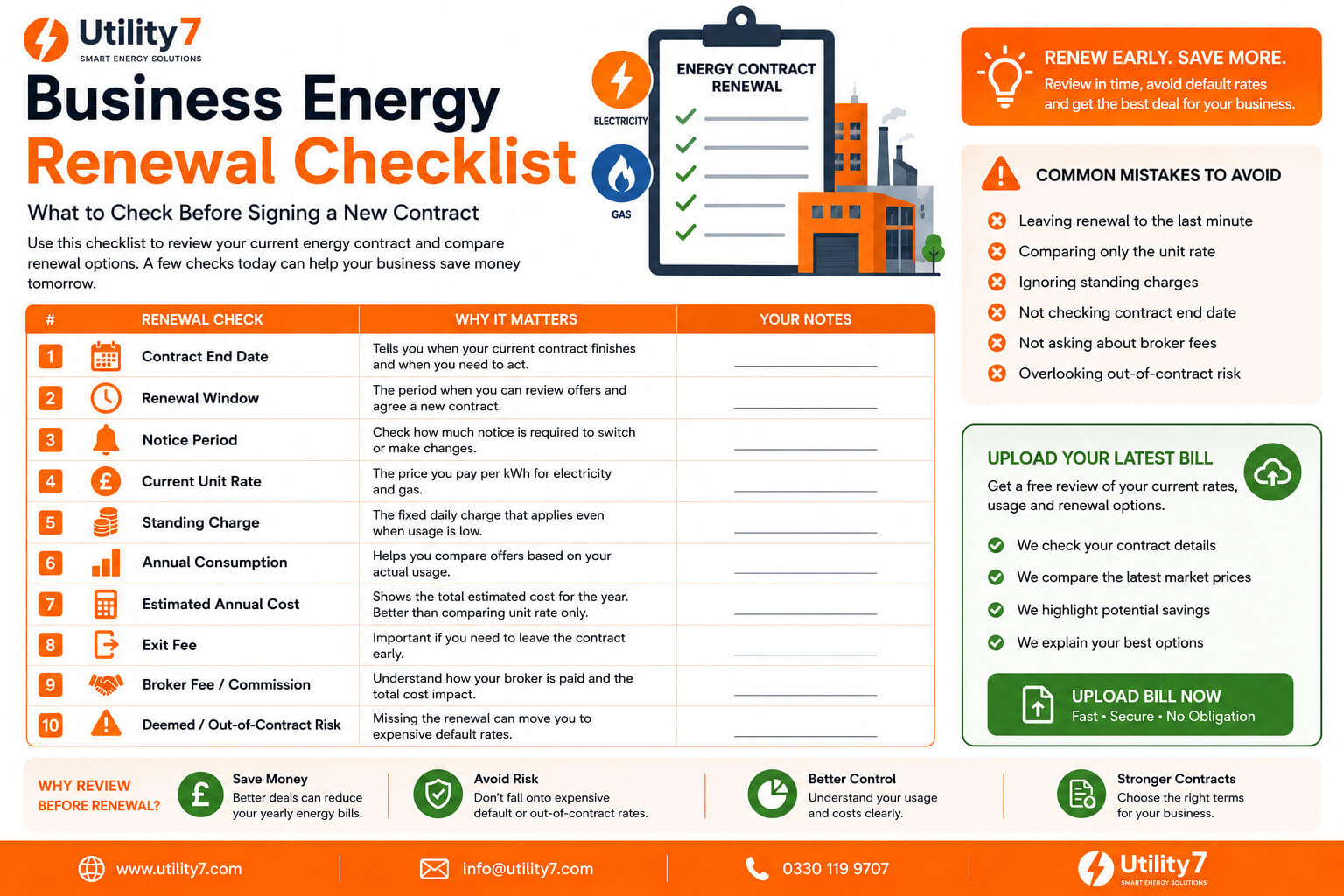
A Business Energy Renewal Checklist helps UK SMEs review the most important details before signing a new gas or electricity contract. Before renewing, check your contract end date, renewal window, notice period, current unit rate, standing charge, annual consumption, estimated annual cost, exit fee, broker fee or commission, and the risk of moving onto deemed or out-of-contract rates.
- Start early: check renewal options before your contract end date.
- Compare total cost: do not compare only the unit rate.
- Check broker fees: understand how your broker or consultant is paid.
- Avoid default rates: missing renewal deadlines can increase costs.
- Best first step: upload your latest bill for a proper review.
Contents
- Business Energy Renewal Checklist: Overview
- Why Energy Renewal Matters for UK SMEs
- Business Energy Renewal Checklist
- 1. Contract End Date
- 2. Renewal Window
- 3. Notice Period
- 4. Current Unit Rate
- 5. Standing Charge
- 6. Annual Consumption
- 7. Estimated Annual Cost
- 8. Exit Fee and Contract Terms
- 9. Broker Fee or Commission
- 10. Deemed and Out-of-Contract Risk
- Latest Bill Upload Checklist
- Common Renewal Mistakes
- How Utility7 Can Help
- Frequently Asked Questions
- Final Thoughts
Business Energy Renewal Checklist: Overview
Business energy renewal is one of the most important times for a UK SME to review gas and electricity costs. If your contract is ending soon, you may receive a renewal offer from your current supplier. You may also have the option to compare other suppliers, review different contract lengths, check broker support or change how your energy is managed.
The problem is that many businesses leave renewal too late. A restaurant, takeaway, cafe, shop, care home, office, warehouse or salon may only notice the contract has ended when a higher bill arrives. By then, the business may already be on out-of-contract rates, deemed rates or another default pricing arrangement.
This Business Energy Renewal Checklist is designed to help UK SMEs check the right details before signing a new contract. It focuses on practical renewal decisions: contract end date, renewal window, notice period, current rates, standing charges, usage, estimated annual cost, exit fee, broker fee and default-rate risk.
The aim is not to choose the cheapest-looking headline rate. The aim is to understand the full contract before signing, so your business can make a more informed decision.
Important note
Business energy contracts are commercial agreements. Always check your own supplier terms, renewal letter, contract end date, notice rules and broker fee arrangement before signing.
Why Energy Renewal Matters for UK SMEs
Energy can be a major overhead for small and medium-sized businesses. Even a small difference in unit rate, standing charge or contract terms can affect total annual cost, especially for high-usage businesses.
Renewal matters because it is often the point where your business can:
- Compare prices before the current contract ends
- Check whether the renewal offer is competitive
- Review contract length and payment terms
- Understand standing charges and unit rates
- Avoid out-of-contract or deemed rates
- Check broker fee or commission transparency
- Update supply information such as MPAN or MPRN
- Review gas, electricity, water and card machine costs together
The earlier you check your renewal position, the more options your business usually has. Waiting until the last minute can reduce choice and increase the risk of moving onto expensive default rates.
Business Energy Renewal Checklist
Use this renewal-focused checklist before agreeing a new business gas or electricity contract.
| Renewal Check | Why It Matters |
|---|---|
| Contract end date | Tells you when your current deal finishes and when you need to act. |
| Renewal window | Helps you know when to compare and agree a new contract. |
| Notice period | Some contracts may need notice before switching or ending certain arrangements. |
| Current unit rate | Shows what you currently pay per kWh of energy used. |
| Standing charge | Fixed daily cost that affects the total bill even when usage is low. |
| Annual consumption | Needed to compare estimated annual costs accurately. |
| Estimated annual cost | Better than comparing only the headline unit rate. |
| Exit fee | Important if you want to leave before the contract end date. |
| Broker fee or commission | Helps you understand the full cost and how advice is paid for. |
| Default-rate risk | Missing renewal can move your business onto deemed or out-of-contract rates. |
1. Contract End Date
Your contract end date is the date your current business energy deal finishes. This is one of the most important details on your bill, renewal letter or supplier portal.
If you miss the end date, your business may lose the chance to compare properly before the contract changes. Some businesses only discover the contract has ended when the next bill arrives at a higher rate.
Check:
- Electricity contract end date
- Gas contract end date
- Whether both contracts end on the same day
- Whether your business has more than one meter or site
- Whether the supplier has sent a renewal notice
Multi-site businesses should keep a simple renewal tracker so each site, meter and contract is reviewed in time.
2. Renewal Window
The renewal window is the period before your contract ends when you can review supplier offers and decide what to do next. For many businesses, this is when suppliers or brokers begin discussing renewal options.
Do not wait until the final few days. Business energy quotes can change, suppliers may need time to process applications and you may need time to compare the full annual cost.
During the renewal window, ask:
- What is my current supplier offering?
- What are other suppliers offering?
- What is the estimated annual cost?
- What contract lengths are available?
- Are the rates fixed, variable or pass-through?
- When will the new contract start?
A renewal window should be treated as a decision period, not just a deadline.
3. Notice Period
Some business energy contracts may include notice requirements or termination rules. This can depend on your supplier, contract type and whether the contract is fixed-term, evergreen or already ended.
Before signing a new contract, check:
- Whether notice is needed
- How notice must be given
- Whether notice must be in writing
- Whether you need confirmation from the supplier
- Whether there is a deadline for giving notice
- Whether the contract has already ended
If you are unsure, contact your supplier and ask for written confirmation of your renewal and notice position.
4. Current Unit Rate
The unit rate is the price your business pays for each kWh of electricity or gas used. It is usually one of the first numbers businesses compare when reviewing renewal offers.
However, the cheapest unit rate is not always the cheapest overall contract. A tariff with a low unit rate may have a higher standing charge, different pass-through costs, longer contract term or other conditions.
Check your current:
- Electricity unit rate
- Gas unit rate
- Day and night rates if you have a multi-rate meter
- Current tariff type
- Whether rates are fixed or variable
For help understanding your electricity bill, read Utility7’s guide on how to read a business electricity bill.
5. Standing Charge
The standing charge is a fixed daily charge that may apply to your gas or electricity supply. It is separate from the unit rate and can affect your total annual cost.
For low-usage businesses, the standing charge can make up a larger share of the total bill. For high-usage businesses, the unit rate may have a bigger impact, but the standing charge should still be checked.
Before renewal, compare:
- Current standing charge
- New standing charge
- Daily cost converted into annual cost
- Standing charge for each meter or supply
- Whether lower standing charge means higher unit rate
For more detail, read Utility7’s guide on Business Electricity Standing Charge Explained.
6. Annual Consumption
Annual consumption is the amount of energy your business uses over a year, usually shown in kWh. It is one of the most important figures for comparing renewal offers.
Without annual consumption, comparisons can be inaccurate. A supplier or broker may estimate usage, but using real usage from bills is usually better.
Check:
- Annual electricity consumption in kWh
- Annual gas consumption in kWh
- Seasonal usage changes
- Whether usage has increased or reduced
- Whether the bill is based on actual or estimated readings
Restaurants, takeaways, hotels, care homes, bakeries, warehouses and manufacturing sites should pay close attention to annual consumption because even a small rate difference can have a large annual impact.
7. Estimated Annual Cost
Estimated annual cost is often the clearest way to compare renewal offers. It combines expected usage, unit rate, standing charge and other relevant charges into a yearly estimate.
A proper comparison should not only show:
- Unit rate
- Standing charge
- Contract length
It should also show:
- Estimated annual cost
- Estimated monthly average
- VAT and CCL treatment where applicable
- Any pass-through or non-commodity cost treatment
- Broker fee or commission arrangement
Comparing estimated annual cost helps avoid the common mistake of choosing a low headline rate that becomes more expensive overall.
8. Exit Fee and Contract Terms
Before signing a business energy renewal, check whether the new contract includes exit fees, termination rules, auto-renewal terms or restrictions.
Ask:
- Is there an exit fee?
- Can I switch before the contract ends?
- What happens if the business moves premises?
- What happens if the business changes ownership?
- What notice is required?
- What happens after the fixed term ends?
- Will rates change if usage is different from the estimate?
Contract terms can matter as much as price. A slightly cheaper quote may not be suitable if the terms are too restrictive for your business.
9. Broker Fee or Commission
Many UK businesses use brokers or consultants to compare energy contracts. This can be helpful, but it is important to understand how the broker is paid.
Broker fees or commission may be:
- Included within the unit rate
- Paid by the supplier
- Charged separately
- Linked to contract length or usage
- Shown in broker documentation or supplier communications
Before signing, ask for clear information about any broker fee, commission or uplift. This helps you understand the true cost of the contract and whether the recommendation is transparent.
A good broker should explain supplier options clearly, show the key contract details and avoid pressure-selling.
10. Deemed and Out-of-Contract Risk
If your business misses the renewal deadline or starts using energy without an agreed contract, you may face default pricing.
Two common default-rate situations are:
- Deemed rates: often apply when a business uses energy without agreeing a contract first, such as after moving into a premises.
- Out-of-contract rates: often apply when a fixed business energy contract ends and no new contract has been agreed.
These rates can be more expensive than negotiated contract rates. The best way to reduce the risk is to review your contract early, keep supplier records updated and agree a suitable contract before the current deal ends.
For more detail, read Utility7’s guide on Deemed Rates vs Out-of-Contract Rates for UK Businesses.
Latest Bill Upload Checklist
Before Utility7 or any adviser can review your renewal properly, your latest bill is usually the best starting point. A full bill helps confirm the correct supply, current costs and contract details.
Upload or prepare a bill that shows:
- Business name
- Supply address
- Supplier name
- MPAN for electricity
- MPRN for gas
- Meter serial number
- Billing period
- Current unit rate
- Standing charge
- Annual or monthly consumption
- Contract end date
- VAT and CCL details
- Total amount due
If you do not have a bill, collect the supply address, meter details and supplier information where possible. For gas, you may need your MPRN. For electricity, you may need your MPAN.
Common Renewal Mistakes
Energy renewal mistakes can lead to higher costs or unsuitable contracts. Avoid these common issues:
- Waiting until the contract has already ended
- Comparing only the unit rate
- Ignoring the standing charge
- Not checking annual consumption
- Not checking contract end date
- Not checking notice period
- Not asking about broker fee or commission
- Signing a long contract without understanding the terms
- Using estimated usage without checking real bills
- Not checking MPAN or MPRN details
- Not reviewing deemed or out-of-contract risk
- Not keeping written confirmation of the contract
A good renewal process should be organised, documented and based on real usage data.
How Utility7 Can Help
Utility7 helps UK businesses review gas and electricity bills, check contract details and compare available business energy options. This Business Energy Renewal Checklist can help you prepare before requesting a quote or renewal review.
Utility7 can help with:
- Reviewing your latest gas or electricity bill
- Checking MPAN and MPRN details
- Identifying unit rates and standing charges
- Checking contract end dates
- Reviewing annual usage
- Comparing estimated annual costs
- Explaining deemed and out-of-contract risk
- Supporting business gas, electricity, water and card machine reviews
Business energy contract ending soon?
Upload your latest business gas or electricity bill to Utility7. Our team can review your current unit rate, standing charge, annual usage, contract end date and available renewal options.
Upload your latest bill or contact Utility7 today
for a free, no-obligation review.
Frequently Asked Questions
What is a Business Energy Renewal Checklist?
A Business Energy Renewal Checklist is a list of key details to review before signing a new gas or electricity contract. It includes contract end date, renewal window, notice period, unit rate, standing charge, annual usage, estimated annual cost, exit fees and broker fees.
When should a business start reviewing energy renewal options?
A business should start reviewing options before the contract end date and before any renewal deadline. Starting early gives more time to compare prices and avoid out-of-contract rates.
What details do I need to compare business energy renewal offers?
You usually need your latest bill, MPAN or MPRN, supply address, current unit rate, standing charge, annual consumption, contract end date and supplier details.
Should I compare unit rate or estimated annual cost?
You should compare the estimated annual cost because it includes both usage and standing charges. Comparing only the unit rate can be misleading.
What happens if my business energy contract ends?
If your contract ends and no new contract is agreed, your business may move onto out-of-contract rates. These can be more expensive than negotiated contract rates.
Should I ask about broker fees?
Yes. You should ask how the broker or consultant is paid, whether commission is included in the unit rate, and whether any separate fees apply.
Can Utility7 review my latest bill?
Yes. Utility7 can review your latest business gas or electricity bill and help explain your current rates, standing charges, annual usage and renewal options.
Final Thoughts
A Business Energy Renewal Checklist helps UK SMEs avoid rushed decisions and expensive default rates. Before signing a new contract, check your contract end date, renewal window, notice period, current unit rate, standing charge, annual consumption, estimated annual cost, exit fee, broker fee and out-of-contract risk.
The best renewal decision is not always the cheapest-looking unit rate. A proper comparison should consider the full annual cost, supplier terms, contract length, fee transparency and your business usage pattern.
If your business energy contract is ending soon, the simplest first step is to upload your latest bill for review. This allows the key details to be checked before you commit to a new deal.
As a Business energy broker UK, Utility7 helps businesses review business electricity, business gas, business water and card machine services.
Methodology and Source Notes
This article has been written using Utility7 service context and UK business energy guidance. It is designed to help SMEs prepare for energy renewal and understand what to check before signing a new contract. Businesses should always confirm their own contract terms, supplier notice requirements, broker fee arrangements and live pricing before agreeing to a renewal.
- Ofgem: Set up a business energy contract
- Ofgem: Get energy for your business
- Citizens Advice: Switching your small business energy supplier
- Citizens Advice: Moving business premises energy supply
- Ofgem: Greater protection for businesses and broker fee transparency
- Energy Ombudsman: Small business energy disputes
- Utility7: Deemed Rates vs Out-of-Contract Rates
- Utility7: How to Read a Business Electricity Bill
- Utility7: Business Electricity Standing Charge Explained
- Contact Utility7