
Quick answer
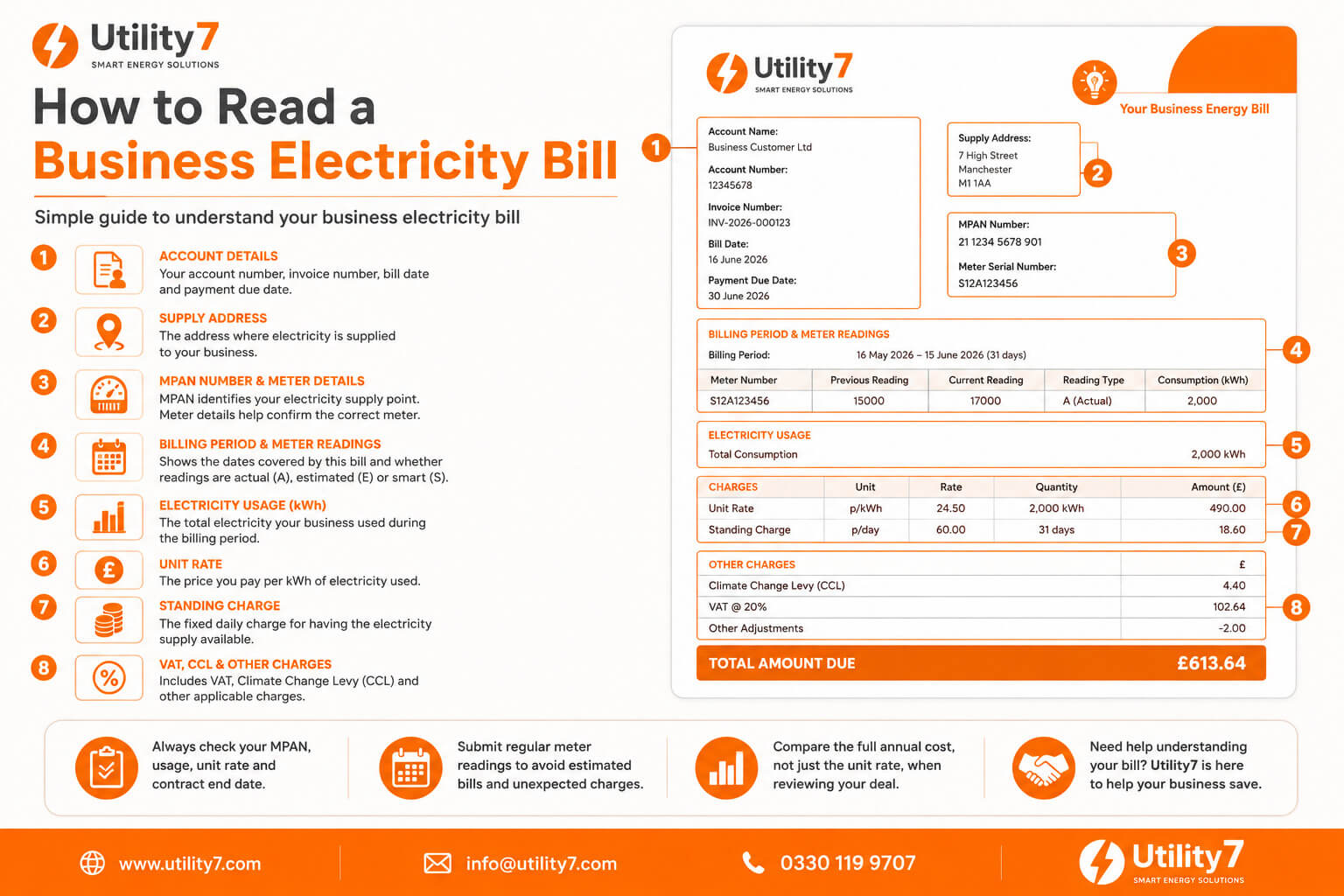
How to read a business electricity bill means checking the key sections that affect your cost: account details, supply address, MPAN number, billing period, meter readings, kWh usage, unit rate, standing charge, VAT, Climate Change Levy, contract end date and total amount due. The most important thing is to compare the full annual cost, not just the unit rate.
- MPAN: identifies your electricity supply point.
- kWh usage: shows how much electricity your business used.
- Unit rate: price per kWh of electricity used.
- Standing charge: fixed daily charge for having the supply available.
- Contract end date: helps avoid expensive out-of-contract rates.
Contents
- How to Read a Business Electricity Bill: Overview
- Business Electricity Bill Quick Checklist
- 1. Account Details and Supply Address
- 2. MPAN Number and Meter Details
- 3. Billing Period and Meter Readings
- 4. Electricity Usage in kWh
- 5. Unit Rate
- 6. Standing Charge
- 7. VAT and Climate Change Levy
- 8. Contract End Date and Tariff Details
- Estimated vs Actual Readings
- Common Charges on a Business Electricity Bill
- How to Use Your Bill to Compare Prices
- Common Mistakes to Avoid
- How Utility7 Can Help
- Frequently Asked Questions
How to Read a Business Electricity Bill: Overview
Business electricity bills can look complicated because they include more than just the amount your business has to pay. A typical bill may show account information, supply address, MPAN, meter serial number, meter readings, electricity usage, unit rates, standing charges, VAT, Climate Change Levy, payment details and tariff information.
If you understand these sections, it becomes easier to spot errors, check whether the bill is estimated or actual, compare electricity rates and avoid expensive contract mistakes.
Many UK businesses only look at the total amount due. This is understandable, but it can hide important issues. For example, your bill may be high because usage increased, the unit rate changed, the standing charge is high, the bill is based on estimated readings, or your contract has ended and you are now on out-of-contract rates.
This guide explains how to read a business electricity bill in a practical way, using the sections most businesses should check before renewal, switching or comparing quotes.
Important note
Supplier bill layouts vary. The wording may look different depending on your supplier, but most business electricity bills include similar core information.
Business Electricity Bill Quick Checklist
Before reading the bill in detail, use this quick checklist. These are the main items that matter for cost, comparison and contract management.
| Bill Item | Why It Matters |
|---|---|
| Supply address | Confirms the bill relates to the correct business premises. |
| MPAN number | Identifies the electricity supply point and helps with comparison or switching. |
| Meter readings | Shows whether the bill is based on actual, estimated or customer readings. |
| kWh usage | Shows how much electricity your business used during the billing period. |
| Unit rate | Shows how much you pay per kWh of electricity used. |
| Standing charge | Shows the fixed daily cost for having the supply available. |
| Contract end date | Helps you avoid renewal mistakes and out-of-contract rates. |
1. Account Details and Supply Address
The first part of a business electricity bill normally includes account details. This may include your customer number, account number, bill number, invoice date, payment due date and supply address.
Check this section carefully, especially if your business has moved premises, changed company name or has multiple sites.
Look for:
- Business name
- Billing address
- Supply address
- Account number
- Invoice number
- Bill date
- Payment due date
- VAT number, if shown
The supply address is especially important. The billing address may be your office or accountant’s address, but the supply address is the premises where electricity is being used.
2. MPAN Number and Meter Details
Your MPAN number identifies your electricity supply point. MPAN stands for Meter Point Administration Number. It is different from your meter serial number.
The MPAN helps suppliers and brokers confirm which electricity supply belongs to your premises. It is useful when comparing business electricity rates or switching supplier.
On your bill, the MPAN may appear under:
- MPAN
- Supply number
- Meter Point Administration Number
- S number
- Electricity supply details
Your bill may also show the meter serial number. This identifies the physical meter installed at your premises. It is useful for checking whether the correct meter is being billed.
For a full explanation, read Utility7’s guide on MPAN Number.
3. Billing Period and Meter Readings
The billing period shows the dates covered by the bill. For example, it may cover one month, one quarter or another billing cycle depending on your supplier and contract.
Meter readings show how much electricity was recorded at the start and end of the billing period. The difference between these readings is used to calculate your usage.
You may see reading labels such as:
- A: Actual reading
- E: Estimated reading
- C: Customer reading
- S: Smart meter reading
The exact labels can vary by supplier. If you are unsure what a letter means on your bill, check the supplier’s bill guide or contact them directly.
Estimated readings can create billing issues. If the estimate is too high, your business may overpay. If it is too low, you may receive a larger catch-up bill later.
4. Electricity Usage in kWh
Electricity usage is measured in kilowatt-hours, usually shown as kWh. This shows how much electricity your business used during the billing period.
For example, if your bill shows 2,000 kWh, your business used 2,000 units of electricity during that billing period.
Usage is one of the most important parts of your bill because it affects your total cost. Even if your unit rate stays the same, your bill can increase if your business uses more electricity.
High-usage businesses may include:
- Restaurants and takeaways
- Cafes and bakeries
- Hotels
- Care homes
- Manufacturing sites
- Warehouses with refrigeration or equipment
- Businesses using electric heating or air conditioning
When comparing prices, always use annual usage if possible. A single monthly bill may not show seasonal patterns.
5. Unit Rate
The unit rate is the price your business pays for each kWh of electricity used. It is usually shown in pence per kWh.
Example:
Electricity usage × unit rate = usage charge
If your business used 1,000 kWh and the unit rate was 25p per kWh, the usage charge would be £250 before VAT and other applicable charges.
The unit rate is important, but it is not the only number to compare. You should also check the standing charge, contract length, VAT, CCL and total annual cost.
6. Standing Charge
The standing charge is a fixed daily charge that may apply to your business electricity supply. It is separate from the unit rate.
Your business may pay the standing charge every day during the billing period, even if electricity usage is low. This can matter for seasonal businesses, low-usage premises and businesses that operate only a few days per week.
Example:
Daily standing charge × number of billing days = standing charge cost
A lower standing charge does not always mean the cheapest deal. Some tariffs have a lower standing charge but a higher unit rate. Read Utility7’s guide on Business Electricity Standing Charge Explained for more detail.
7. VAT and Climate Change Levy
Your business electricity bill may include VAT and Climate Change Levy, often called CCL.
Most business energy bills are charged VAT at the standard business rate. Some businesses may qualify for reduced VAT in specific circumstances, such as qualifying charitable or domestic use, or very low average energy use. The supplier may require a declaration before applying reduced VAT.
Climate Change Levy is a government charge applied to business energy usage in many cases. It is designed to encourage energy efficiency and reduce emissions. Some businesses or certain uses may qualify for exemption or relief, but this depends on eligibility and documentation.
On your bill, check whether VAT and CCL are shown separately. If you believe your business qualifies for reduced VAT or CCL relief, contact your supplier or accountant for guidance.
8. Contract End Date and Tariff Details
One of the most important parts of a business electricity bill is the contract information. This can help you avoid renewal mistakes and expensive out-of-contract rates.
Look for:
- Contract start date
- Contract end date
- Tariff name
- Fixed or variable tariff
- Renewal window
- Exit fees, if applicable
- Payment method
- Estimated annual consumption
If your contract has ended and no new deal has been agreed, your business may move onto out-of-contract rates. These can be more expensive than negotiated contract rates.
Read Utility7’s guide on Deemed Rates vs Out-of-Contract Rates for UK Businesses for more detail.
Estimated vs Actual Readings
A business electricity bill may be based on actual, estimated, customer or smart meter readings. This matters because estimated bills can be inaccurate.
If your bill is estimated, compare it with the current meter reading. If the estimate is wrong, submit a meter reading to the supplier.
Estimated readings can cause:
- Overpayment if estimated usage is too high
- Underpayment if estimated usage is too low
- Unexpected catch-up bills
- Confusion when comparing suppliers
- Wrong annual usage estimates
Smart meters can reduce the need for manual readings, but businesses should still review bills to make sure charges look reasonable.
Common Charges on a Business Electricity Bill
Business electricity bills can include different cost components. Some are shown clearly, while others may be built into the unit rate depending on contract type.
| Charge | Meaning |
|---|---|
| Unit rate | The price per kWh of electricity used. |
| Standing charge | Fixed daily charge for having the electricity supply available. |
| VAT | Tax applied to the bill, usually at the standard business rate unless reduced-rate rules apply. |
| Climate Change Levy | A government levy on business energy usage, subject to eligibility and exemptions. |
| Network and metering costs | Costs linked to electricity distribution, transmission, metering and supply infrastructure. |
| Balance adjustment | Debit or credit carried forward from previous bills or payments. |
For larger or more detailed bills, you may also see pass-through or non-commodity charges. These can include network, policy, system and market-related costs. Read Utility7’s guide on Business Electricity Non-Commodity Charges for more detail.
How to Use Your Bill to Compare Prices
Once you understand how to read a business electricity bill, you can use it to compare supplier options more accurately.
Before comparing, collect:
- Latest business electricity bill
- MPAN number
- Supply address
- Current supplier
- Current unit rate
- Current standing charge
- Annual usage in kWh
- Contract end date
- Meter type
- Payment method
A good comparison should show the estimated annual cost. This is better than comparing only the unit rate because two quotes can have different standing charges, contract lengths and payment terms.
Common Mistakes to Avoid
Business electricity bills can be confusing, and small mistakes can lead to higher costs or poor contract decisions.
Avoid these common mistakes:
- Only checking the total amount due.
- Ignoring whether the bill is estimated or actual.
- Not checking the MPAN number.
- Comparing quotes without annual kWh usage.
- Choosing a deal based only on the unit rate.
- Ignoring the standing charge.
- Missing the contract end date.
- Letting the contract move onto out-of-contract rates.
- Not checking VAT and CCL treatment.
- Not keeping copies of bills for comparison.
The best habit is to review your bill regularly and record your key contract details in a simple tracker.
How Utility7 Can Help
Utility7 helps UK businesses review electricity bills, understand charges and compare available business electricity options. If you are unsure how to read a business electricity bill, Utility7 can help identify the key details that matter for comparison.
Utility7 can help with:
- Reading and reviewing business electricity bills
- Identifying MPAN numbers
- Checking unit rates and standing charges
- Reviewing annual kWh usage
- Checking contract end dates
- Explaining estimated vs actual readings
- Comparing available business electricity options
- Reviewing gas, water and card machine services
Need help reading your business electricity bill?
Send your latest business electricity bill to Utility7. Our team can help review your MPAN, usage, unit rate, standing charge and contract end date.
Contact Utility7 today
for a free, no-obligation review.
Frequently Asked Questions
How do I read a business electricity bill?
Start by checking the supply address, MPAN, billing period, meter readings, kWh usage, unit rate, standing charge, VAT, CCL, contract end date and total amount due. These details explain how your bill has been calculated.
What is the most important number on a business electricity bill?
The most important details are usually the MPAN, annual usage in kWh, unit rate, standing charge and contract end date. These help when comparing business electricity prices.
What does kWh mean on a business electricity bill?
kWh stands for kilowatt-hour. It is the unit used to measure how much electricity your business has used.
What is an MPAN number?
An MPAN number is the reference used to identify your electricity supply point. It is different from the meter serial number.
Why is my business electricity bill estimated?
Your bill may be estimated if the supplier did not receive an actual meter reading. Submit a current reading to help correct the account.
What is a standing charge on a business electricity bill?
A standing charge is a fixed daily charge that may apply for having the electricity supply available at your premises. It is separate from the unit rate.
Can Utility7 help me understand my electricity bill?
Yes. Utility7 can review your latest business electricity bill and help explain the key details needed for comparison, including MPAN, usage, unit rate, standing charge and contract end date.
Final Thoughts
Understanding how to read a business electricity bill helps your business make better decisions. Instead of only checking the amount due, you can see how the bill is calculated and whether your current contract is still suitable.
The key details to check are your MPAN number, billing period, meter readings, kWh usage, unit rate, standing charge, VAT, CCL and contract end date. These details help you understand your bill and compare available business electricity options more accurately.
If your bill is estimated, unusually high or close to renewal, it is worth reviewing it properly before agreeing to a new contract.
As a Business energy broker UK, Utility7 helps businesses review gas and electricity costs and compare available options clearly. Utility7 also supports business electricity, business gas, business water and card machine services.
Methodology and Source Notes
This article has been written using Utility7 service context and UK business energy guidance. It is designed to help businesses understand how to read a business electricity bill and identify the key details needed for comparison. Businesses should always check their own supplier bill, contract terms and live pricing before agreeing to any electricity contract.
- Ofgem: Get energy for your business
- British Gas: Your gas and electricity bill explained
- EDF Energy: Understanding your electricity bill
- EDF Energy: VAT and CCL explained
- Utility7 Business Electricity
- Utility7: MPAN Number Guide
- Utility7: Business Electricity Standing Charge Explained
- Contact Utility7